AZ-NV-UT Tri-State Monument in Mesquite, Nevada
Many political boundaries in the western US, as around the world, were drawn along lines of latitude or longitude. This was convenient for politicians looking at maps, but it's much easier to draw a line on the map than to establish that line on the ground—particularly with 19th-century technology. The mutual corner of Arizona, Utah, and Nevada is a case in point. In theory the boundary of Utah…
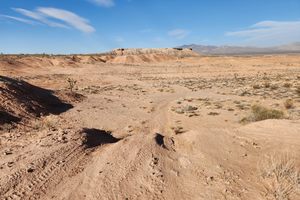
The tri-state point of intersection between Arizona, Utah, and Nevada was initially surveyed in 1870 by Isaac P. James, an astronomer and surveyor. This point, which lies on the 37th parallel of latitude and the meridian at 114°2'W, was marked by the James monument. However, the original survey faced challenges due to the limitations of 19th-century technology and the inherent difficulties in determining longitude with precision, particularly on horseback under primitive conditions.
In 1900, a resurvey was conducted, but it was found that the James monument was located 111.51 chains too far north—a mistake that amounted to nearly 1.5 miles. Despite this significant error, the 1900 resurvey was deemed a notable improvement over the initial measurement. Nevertheless, it became evident that further refinement was necessary.
In 2016, the Utah Council of Land Surveyors, along with the state survey societies of Arizona and Nevada, proposed re-monumenting the tri-point using modern GPS technology with sub-centimeter accuracy. This proposal was widely embraced, and the tri-state monument was subsequently resurveyed. The 1901 monument, which had been placed at the incorrect location, was removed and is now displayed at the Washington County Administration Office in St. George, Utah.
The current monument was then constructed in its correct position. This enhanced surveying method suggests that further resurveys may not be required, ensuring the accuracy of the tri-state boundary for generations to come.
Written by urgent.news from Atlas Obscura's reporting — not their text. Machine-written — may contain errors; check the original before relying on it.