Webb opens a Treasure Chest filled with stars
Image: This NASA/ESA/CSA James Webb Space Telescope Picture of the Month takes us to a fantastical realm within our home galaxy , where piercing starlight and billowing winds sculpt dust clouds into inventive shapes. This scene is from the Carina Nebula, which lies just 7500 light-years away in the constellation Carina (the Keel). Spanning roughly 260 light-years, the nebula is home to an…
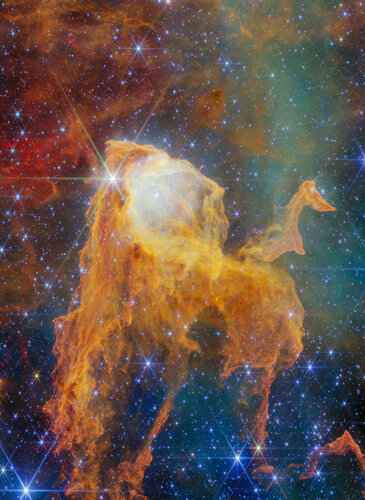
In the Carina Nebula, a stellar wonderland some 7,500 light-years away, NASA's James Webb Space Telescope unveils a dazzling treasure chest known as a cometary globule. This celestial sculpture, replete with a dense dark head and sweeping tail, is situated within a region teeming with massive stars and thousands of protostars. Nestled within the nebula's dust clouds is a compact cluster of youthful stars, estimated to contain around 70 of them, the brightest among which is an O-type star roughly 19 times the Sun's mass.
Still in its infancy, this star cluster is embedded in the nebula's dust and shrouded by circumstellar discs. As the powerful starlight from these nascent stars dissipates the surrounding gas, the entire cluster will become visible. The chest's remarkable shape is attributed to the nearby star Eta Carinae, a luminous behemoth 100 times more massive than the Sun, and its surrounding Trumpler 16 star cluster, both of which harbor exceptionally hot, massive stars.
Written by urgent.news from ESA Space Science's reporting — not their text. Machine-written — may contain errors; check the original before relying on it.