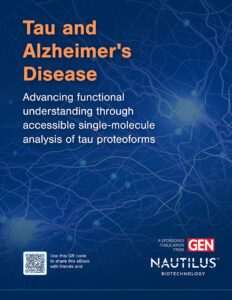
Tau and Alzheimer’s Disease
In this edition of the Nautilus Biotechnology “Proteomics and neuroscience” eBook, we’re excited to dive into tau biology, share what researchers are learning about tau and its role in Alzheimer’s disease using the Nautilus Voyager Platform, and invite you to use the Nautilus Voyager Platform in your own work through the Iterative Mapping Early Access Program. The post Tau and Alzheimer’s Disease…
In recent decades, there have been significant advancements in Alzheimer's disease (AD) research, including the introduction of innovative brain imaging techniques, novel biomarkers, and immunotherapies targeting core AD proteins. Researchers have come to recognize the need for a more comprehensive understanding of the proteins associated with the disease to better stage patients and develop more effective treatments.
Among these proteins is microtubule-associated protein tau, which forms aggregates in AD patients' brains and is intricately linked to cognitive decline. While researchers have made progress in targeting tau and other AD proteins, current treatments only modestly slow, but fail to prevent, cognitive decline. As part of Nautilus' efforts to further this research, they are utilizing the Nautilus Voyager™ Platform and its Iterative Mapping methodology to delve deeper into AD and other neurodegenerative diseases.
Specifically, they are employing the Tau Proteoforms Assay to measure tau variants or proteoforms, which are distinct versions of proteins present in biological systems, at a single-molecule resolution. This in-depth exploration aims to uncover how alterations in the previously unseen proteoform landscape could play a role in the disease.
In this edition of the Nautilus Biotechnology "Proteomics and neuroscience" eBook, readers will learn about the latest findings on tau's role in AD, as well as be invited to utilize the Nautilus Voyager Platform through the Iterative Mapping Early Access Program. The initial offering of this program is the Tau Proteoforms Assay, with more to follow, including comprehensive proteomics and additional proteoforms.
Written by urgent.news from GEN Biotechnology's reporting — not their text. Machine-written — may contain errors; check the original before relying on it.