Most-detailed-ever view of the sun's surface revealed in new images from the world's largest solar telescope
For the first time, scientists have directly observed a 150-year-old predicted phenomenon on the sun's surface that could explain why the sun's atmosphere is far hotter than its surface.
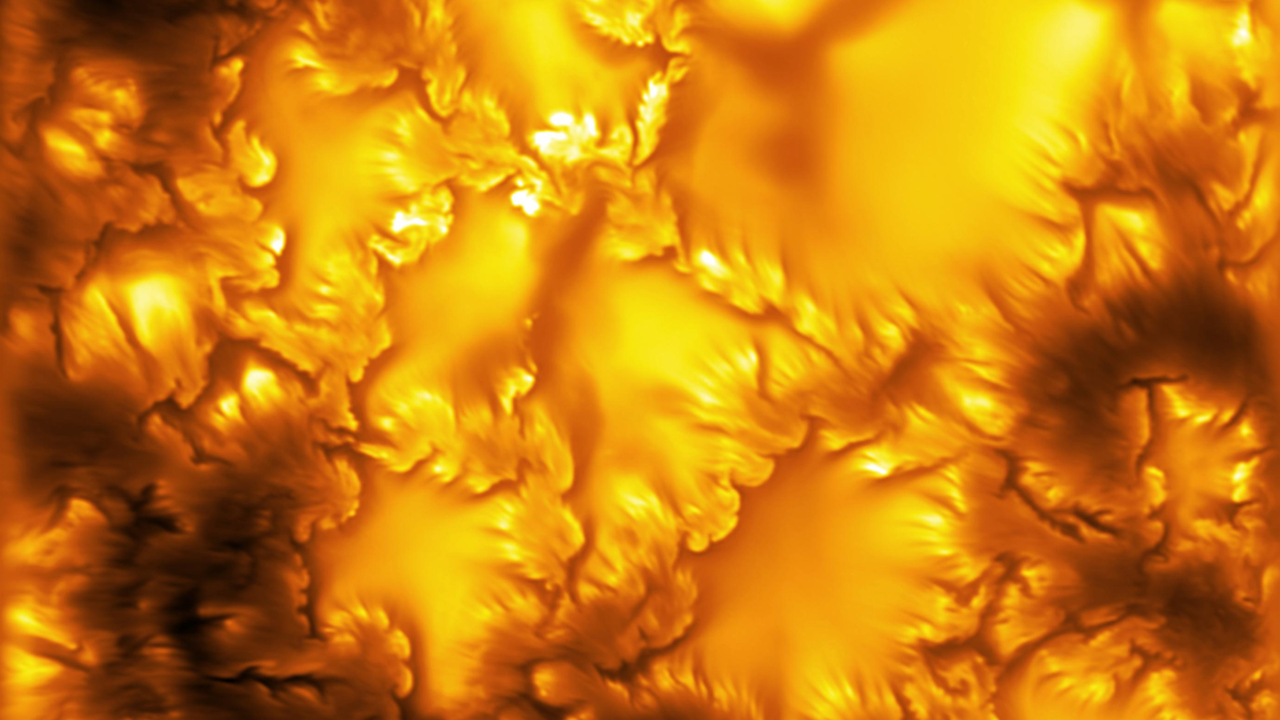
A groundbreaking view of the sun's surface has been captured by the world's most powerful solar telescope, revealing thousands of tiny whirlpools that had gone unnoticed for 150 years. These observations, published in the journal Nature, could unlock insights into the sun's violent behavior and the mystery of its outer atmosphere, known as the corona.
The ultra-detailed time-lapse footage, taken by the Daniel K. Inouye Solar Telescope in Hawaii, provides the first direct proof of a phenomenon called Kelvin-Helmholtz instability. This effect, named after physicists Lord Kelvin and Hermann von Helmholtz, describes the formation of spiraling patterns when two fluids slide past each other at different speeds.
The Inouye telescope's advanced resolution allowed scientists to detect structures as small as tens of miles across, confirming the existence of these previously undetected vortices. By comparing the telescope's images with computer simulations of the sun's photosphere, researchers were able to conclude that the observed vortices align with the predicted instability.
These swirling structures, which twist and mix the sun's magnetic-field lines, may contribute to the generation of energy behind solar flares and coronal mass ejections. This discovery could also help explain why the sun's corona reaches such high temperatures. The team plans to use computer programs to automatically track these vortices in future observations, allowing them to measure their contribution to the corona's heating and the resulting space weather that can disrupt satellites, communications, and power grids on Earth.
Written by urgent.news from Live Science's reporting — not their text. Machine-written — may contain errors; check the original before relying on it.


