James Webb’s little red dots may be monster stars that seeded black holes
Recent findings indicate that colossal "monster stars," reaching masses up to 100,000 times that of our Sun, may hold the key to understanding the enigmatic "little red dots" observed in the early universe. These gigantic stars, through their tumultuous pulsations, generate dense gas shells that may facilitate the swift emergence of supermassive black holes. This innovative research presents a…
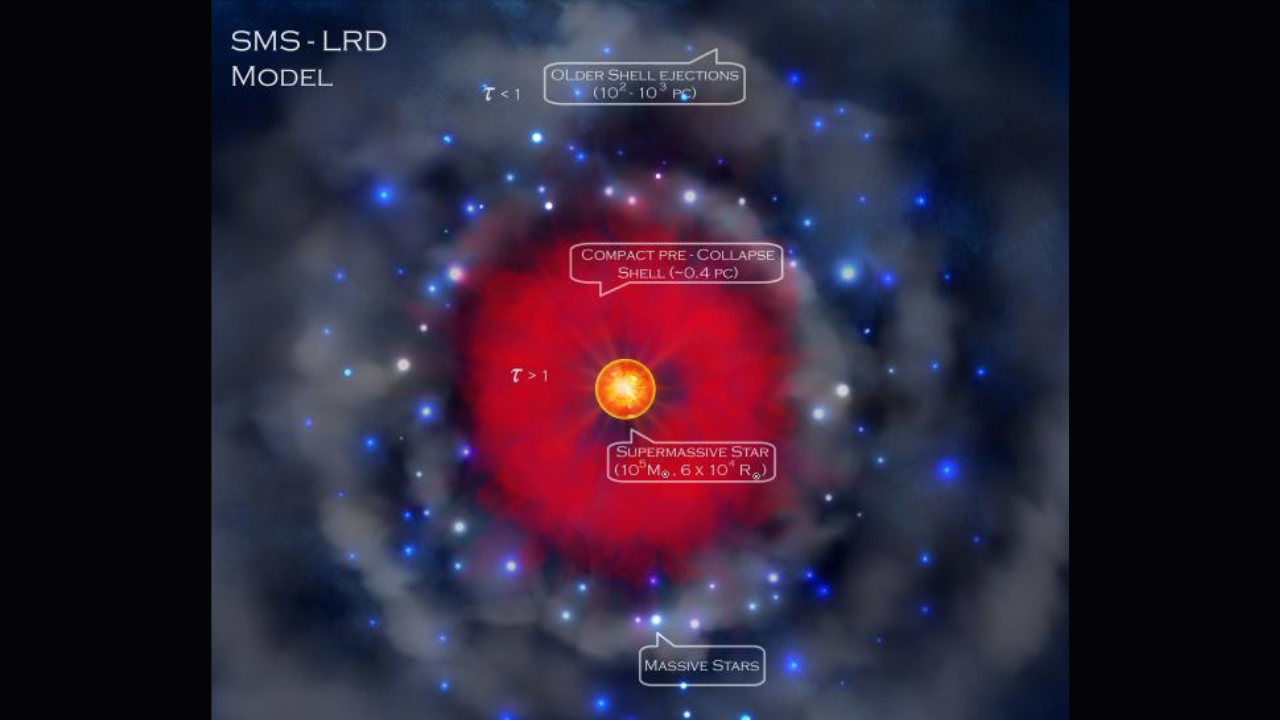
Mysterious, compact objects found in the early universe might actually be gigantic monster stars with masses up to 100,000 times that of our Sun. These "little red dots" detected by the James Webb Space Telescope could potentially explain how the universe's first supermassive black holes formed so rapidly, less than a billion years after the Big Bang.
Led by Devesh Nandal of the Harvard College Observatory, the study proposes a single model that matches the objects' light spectrum, compact appearance, and chemical makeup, suggesting that these massive stars undergo violent mass loss before collapsing into black holes. The team's model answers several puzzles, from the stars' unusual light patterns to the dense gas clouds surrounding the objects, which would typically be found around supermassive black holes.
This proposed solution unifies various independent clues into one coherent physical picture, hinting that these supermassive stars may indeed be the progenitors of the universe's most massive black holes.
Written by urgent.news from Times of India's reporting — not their text. Machine-written — may contain errors; check the original before relying on it.