Is the Universe truly infinite in size?
13.8 billion years ago, the most consequential event in our entire Universe occurred, as cosmic inflation came to an end and the hot Big Bang emerged in its aftermath. The conditions, at that moment, were that the Universe was filled with matter, antimatter, and radiation, and existed in an ultra-hot, ultra-dense, but rapidly expanding-and-cooling state. By the time we arrive at the present day,…
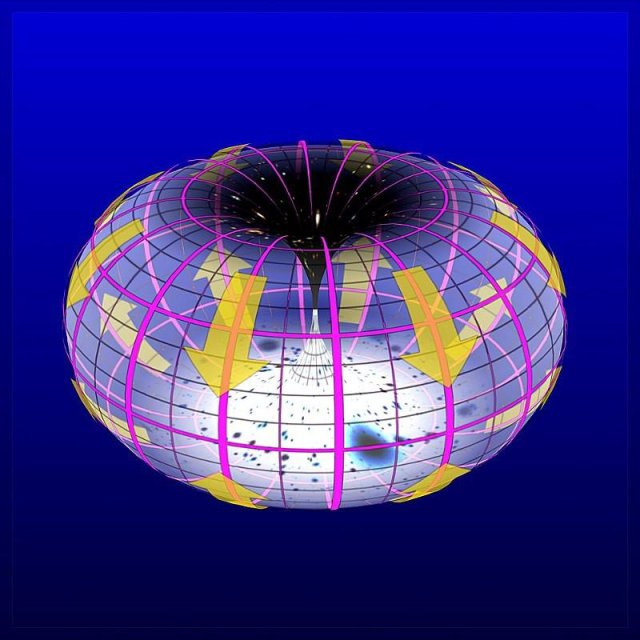
The story investigates whether the universe is truly infinite in size. Cosmic inflation in the early universe gave way to the hot Big Bang, with the matter, antimatter, and radiation filling the ultra-hot, ultra-dense state which rapidly expanded and cooled. The observable Universe currently has a volume of approximately 46 billion light-years in radius, but it's not infinite as it's merely the observable limit.
Beyond this limit lies the unobservable universe. The story delves into how looking farther away means looking farther back in time due to light's finite travel speed. Distances to galaxies vary, from just over 1.25 seconds for the Moon, 8 minutes for the Sun, to 22 minutes for Mars. The nearest major galaxy, Andromeda, is 2.5 million light-years away, appearing as it was 2.5 million years ago.
As we look farther, we see the universe evolving from a hot, dense, uniform state to a colder, clumpier, and more uniform one. This has been confirmed through the cosmic microwave background radiation, which matches predictions made by the Big Bang model. Early in the universe's life, before neutral atoms formed, the universe was an ionized plasma of free electrons and photons, scattering light.
After neutral atoms formed due to cooling, photons traveled in straight lines unaffected except by the expansion of space. The uniformity of the early universe is another remarkable property.
Written by urgent.news from Big Think's reporting — not their text. Machine-written — may contain errors; check the original before relying on it.