Trump's golden age reality check
The Trump administration's rosy promises of a new "golden age" with 6% economic growth have fizzled on the realities of slower-than-anticipated growth and souring consumer sentiment. Why it matters: President Trump's roller coaster economy has risen with consumer spending and AI investment but also tumbled on tariff uncertainty, stubborn inflation and his Iran war, muddling the economic picture.…
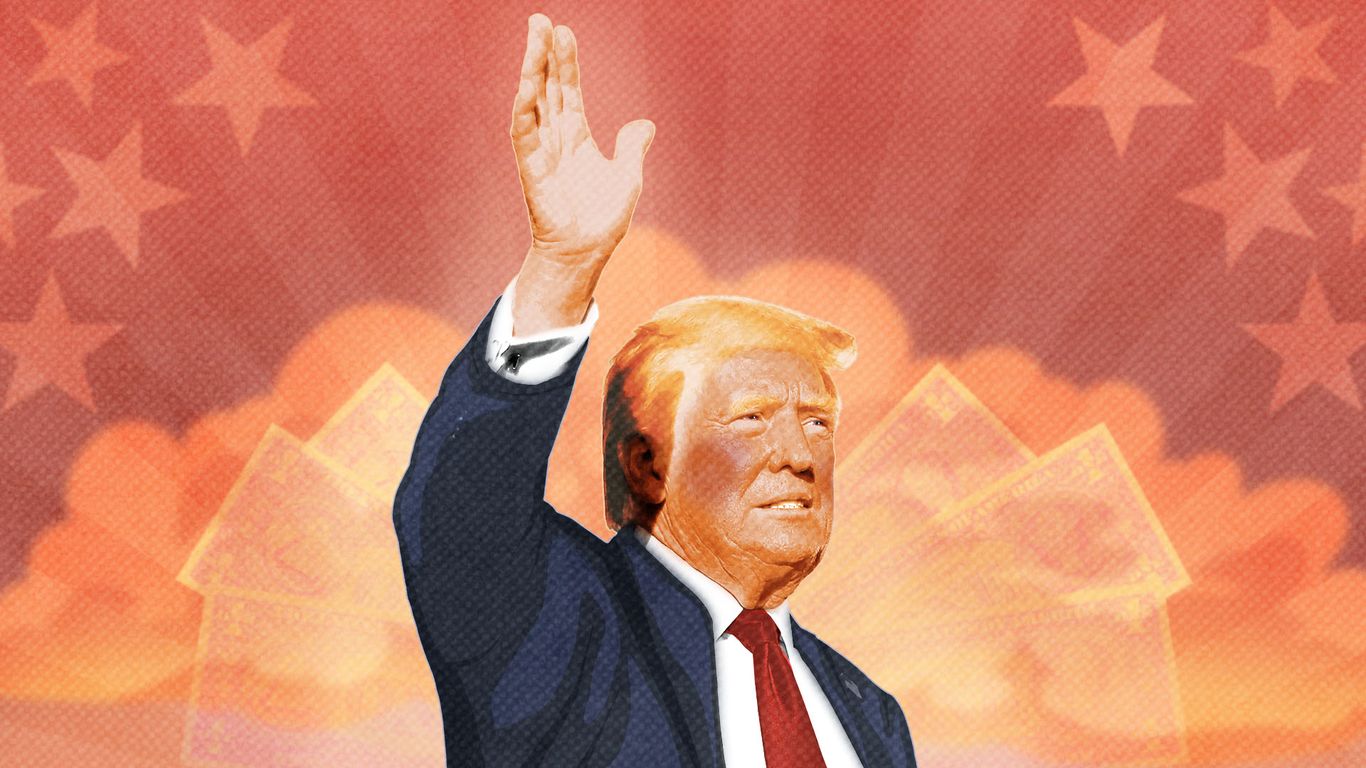
The Trump administration's optimistic claims of a "golden age" with 6% economic growth have proven to be an illusion, overshadowed by slower-than-expected growth and a decline in consumer confidence. Despite a rise in consumer spending and AI investment, the economy has been hampered by tariff uncertainty, persistent inflation, and conflicts in Iran, complicating the economic outlook.
In a recent Reuters-Ipsos poll, Americans expressed a preference for Democrats over Republicans on economic policy for the first time in nearly a decade, signaling a potential warning for the upcoming midterms.
As the second year of Trump's second term unfolds, the economy has demonstrated resilience, aided by an AI infrastructure buildout transcending political divides. However, the administration's ambitious growth targets have yet to be realized. Economists argue that the administration's most ambitious growth goals require a productivity surge far beyond what is currently observed.
The economy expanded by 1.5% in the second quarter, a modest pace that aligns with the long-term trend and falls short of the high growth rates some of Trump's economic officials have advocated for.
Commerce Secretary Howard Lutnick had previously predicted growth could reach 5% in the first quarter, even 6% with lower interest rates, but these projections did not materialize. White House economist Kevin Hassett had once predicted a 6% growth rate, attributing the boost to future factory expansion. Treasury Secretary Scott Bessent's "3-3-3" economic plan aims for sustained 3% annual growth.
However, the Congressional Budget Office estimates potential GDP growth will average about 2% over the next decade, making the high-end predictions unrealistic, according to Michael Klein, an economics professor at Tuft University.
Former Bessent advisor Joseph Lavorgna suggests that 3% growth is plausible, acknowledging that the recent 1.5% GDP print did not fully capture the economy's robustness. Adjusting for trade, inventory, and government spending fluctuations, underlying demand grew at a 3.9% annualized pace in the second quarter. Fox Business' Maria Bartiromo questioned Hassett's recent forecast of 4% growth for the second half of the year, to which Hassett argued the discussion pertained to domestic demand rather than the overall GDP number.
White House spokesperson Kush Desai maintained that the Q2 GDP report affirmed the American consumer's resilience and the long-term restoration of the nation's industrial base.
As the administration recently touted a "nowcast" from the Atlanta Fed forecasting growth at a robust 6% annualized pace, economists remain cautious about this early-quarter estimate, which can fluctuate significantly as more data becomes available. Experts warn that significant productivity gains would be required to achieve 4% or 5% growth, considering a stagnant workforce. The dynamics suggest that attaining such high growth rates may be improbable in the near future.
Written by urgent.news from Axios's reporting — not their text. Machine-written — may contain errors; check the original before relying on it.