Sustainability is not a CSR checkbox. It's now shaping boardroom decisions, executive pay and business strategy
At the Mint Sustainability Summit 2026, sustainability leaders from India's top companies said ESG is now central to growth, risk management and long-term competitiveness—not merely a compliance exercise.
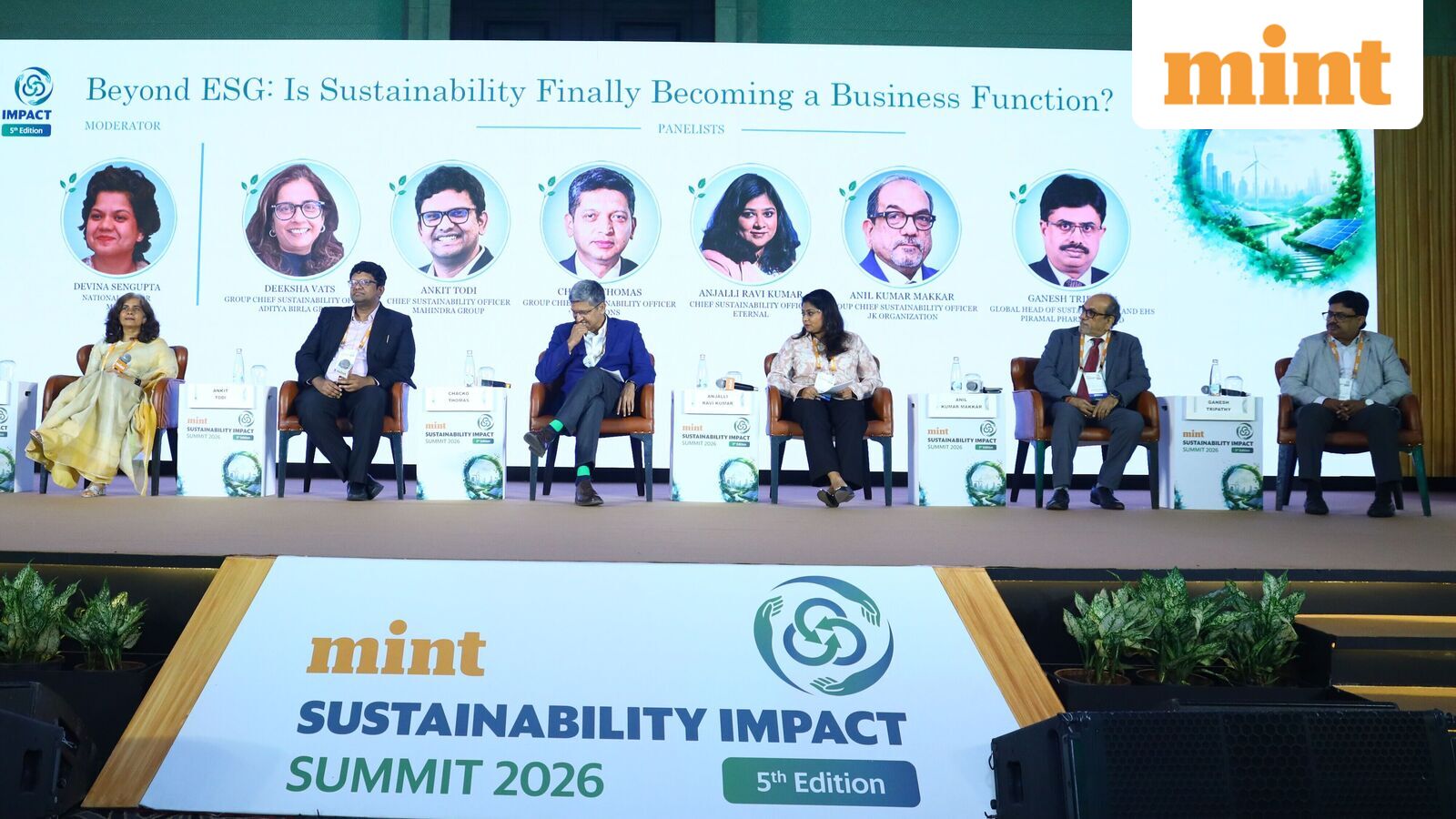
Sustainability is no longer seen as mere compliance by India's top companies. Business leaders from major conglomerates, including Tata Sons, Aditya Birla Group, Tata, Mahindra Group and Piramal Pharma, have said it is now a core part of their business strategy. The discussion took place at the Mint Sustainability Summit 2026, where the executives emphasized that sustainability is vital for growth, risk management and long-term competitiveness.
It involves not just environmental responsibility but also business risk, opportunity and, in some cases, survival.
Piramal Pharma, for example, operates some plants using biomass rather than cheaper coal. Their global head of sustainability and EHS, Ganesh Tripathy, explained that sustainability should not only benefit the business but also society at large. He noted that the company's share of green energy operations has increased significantly from 7% to 26% in just three years.
At Tata Sons, the sustainability journey was given a new direction in 2021 with Project Aalingana, aiming for net-zero emissions by 2045. Their chief sustainability officer, Chacko Thomas, discussed how sustainability is now tied to executive compensation, with performance metrics in Tata Motors directly affected by sustainability standards.
Other companies like Mahindra Group and Eternal also shared their experiences. While Mahindra's chief sustainability officer, Ankit Todi, highlighted that certain sustainability projects like energy efficiency and renewable energy are supported due to their financial returns, he emphasized the need for greater engagement in areas like water conservation and heat mitigation.
Eternal's CEO, Anjalli Ravi Kumar, discussed how a failed sustainability initiative, such as delivery partner rest shelters, can lead to a change in strategy. They now partner with petrol stations and restaurants, making the initiative more practical and valuable for the employees.
JK Organisation's chief sustainability officer, Anil Kumar Makkar, noted that while India's sustainability regulations are currently relatively limited, the Business Responsibility and Sustainability Reporting (BRSR) is a primary requirement. He also pointed out that carbon trading might be the next major regulatory milestone. Lastly, Aditya Birla Group's chief sustainability officer, Deeksha Vats, highlighted that the role of a chief sustainability officer (CSO) has evolved into that of a strategic advisor, guiding businesses through changing regulations, risks and opportunities.
She stressed the importance of contextualizing sustainability efforts to align with each organization's unique context and pace.
Written by urgent.news from Live Mint's reporting — not their text. Machine-written — may contain errors; check the original before relying on it.