Scientists capture highest-resolution photos of the Sun’s surface ever, revealing “tiny engines” driving solar activity
Astrophysicists used a solar telescope fitted with a high-speed camera to capture the frames, which revealed Kelvin-Helmholtz instabilities, a process they now think may be key to understanding how the Sun generates heat
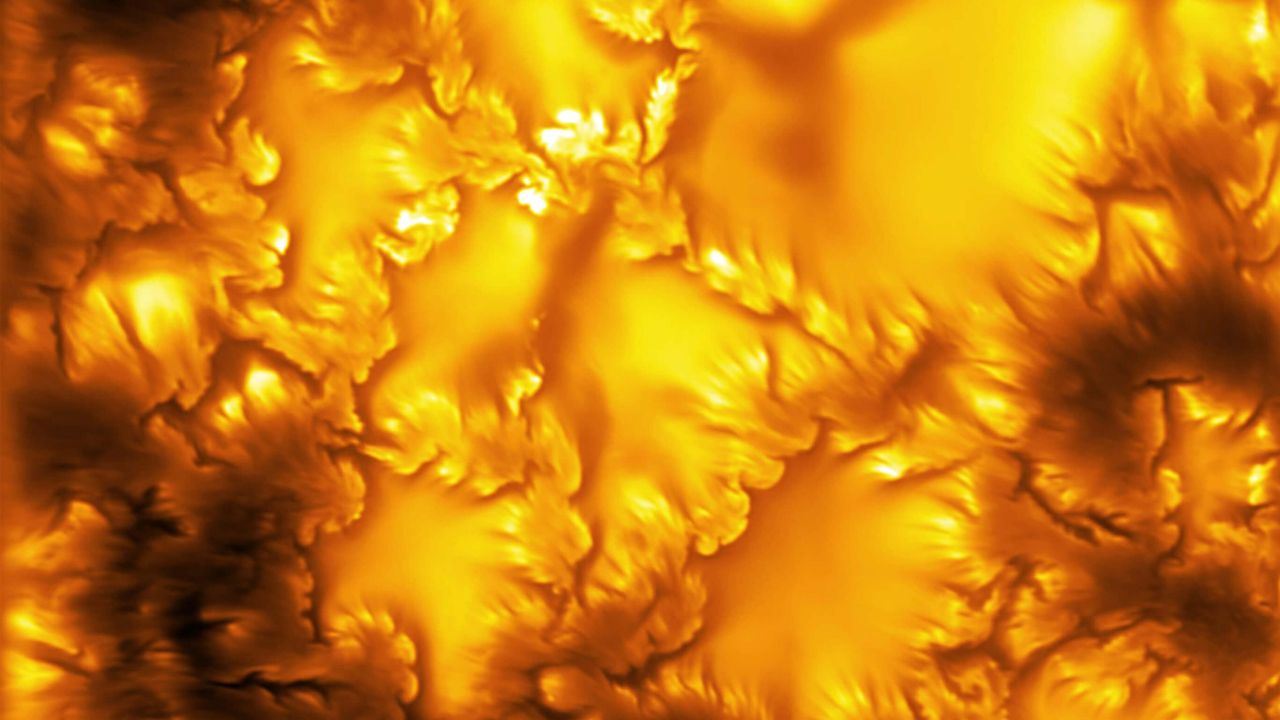
Scientists have achieved the highest-ever resolution images of the Sun's surface, unveiling a solar process crucial for comprehending how the star generates heat. Astrophysicists at the National Science Foundation's National Solar Observatory (NSO) in Boulder, Colorado, utilized the Daniel K. Inouye Solar Telescope (DKIST) in Hawaii to capture these images.
The photos illustrate Kelvin-Helmholtz instabilities (KHIs), a phenomenon that had previously been observed in the Sun's corona but never in its photosphere, the lower layer emitting most of its light. Dr. Friedrich Wöger, co-lead of the study, stated that the new DKIST images reveal "tiny engines" driving solar activity, providing a clearer view of these processes.
The DKIST's high-speed camera, FastCam, took 740 grayscale frames per second with an exposure time of 1/10,000 of a second per frame, offering 2.1 megapixels of sensor area. The images, initially not intended to showcase KHIs, turned out to be a "happy accident" that solved one of the Sun's many mysteries. Dr. Wöger emphasized that understanding these small-scale physical processes is key to forecasting the Sun's disruptive behaviors and improving our overall comprehension of the star.
Written by urgent.news from Digital Camera World's reporting — not their text. Machine-written — may contain errors; check the original before relying on it.