Inflation: Low water levels on the Rhine can apparently drive inflation upwards
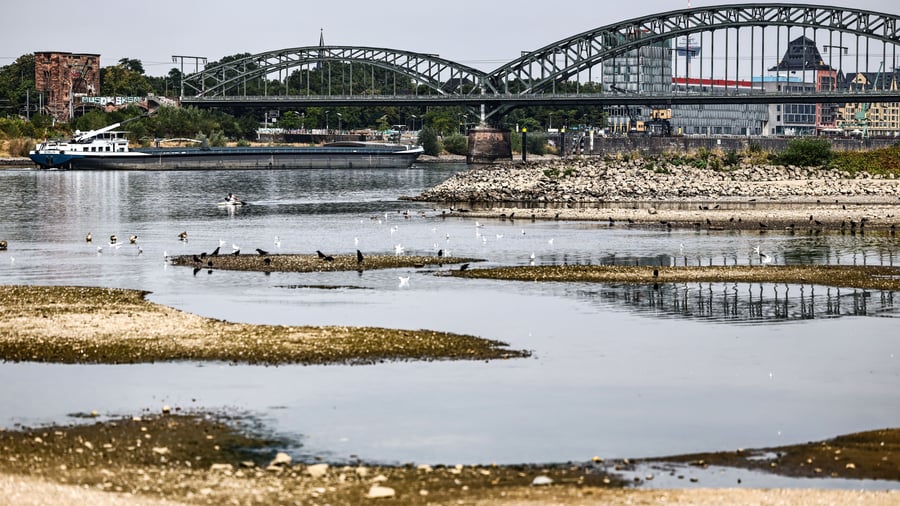
The historically low water levels in the Rhine could lead to delivery shortages. This could also cause the inflation rate to rise, warn economists.
Bank economists are warning of rising inflation as a result of the persistent low water levels in the Rhine. "The German inflation rate could temporarily increase by up to half a percentage point due to this," said economist Felix Schmidt from Berenberg Bank on Wednesday to the Reuters news agency. ING chief economist Carsten Brzeski also expects consequences for the cost of living. Possible delivery delays and associated shortages could make many products more expensive.
"The prices of oil products like diesel are already high compared to crude oil, because refineries in the Gulf states and in Russia have been knocked out by war," explained Commerzbank chief economist Jörg Krämer. "Inflationary pressure is likely to increase from this side due to the low water levels in the Rhine." The early start to the low water levels suggested that transport problems would persist for some time. In the past, the water level had usually risen significantly again in November.
The low water levels are increasing transport costs for all kinds of raw materials, especially from the chemical industry and energy resources, said Cyrus de la Rubia, chief economist at Hamburg Commercial Bank. "Because if ships can only be loaded to a third or less, more ships have to be deployed or more expensive transport routes like trucks or trains are chosen."
According to traders, the costs for transport by tanker and inland waterway ships from Rotterdam to Karlsruhe have currently risen to around €150-160 per tonne, compared to €45 at the end of June.
De la Rubia mentioned another effect: "The electricity prices on the electricity exchange have also risen sharply." Power plants usually require cooling, which is often provided by river water. In Hungary, this has already been observed as an extreme case: the Paks nuclear power plant was close to being shut down. "In principle, this can also have a stronger effect in other European countries and thus also drive up our electricity costs sustainably," emphasised the expert.
However, the most direct effect of the low water levels on inflation is likely to be through higher fuel prices. "This poses a particular price risk for fuels and heating oil, as the Rhine is an important transport axis for petroleum products," said Berenberg expert Schmidt. However, the effect could be overshadowed by developments in the Middle East, where hopes of a peaceful solution had recently pushed oil prices down.
"The European Central Bank will certainly look through such temporary effects," said Schmidt with a view to the ECB's monetary policy. Regional differences in fuel prices The low water levels on the Rhine are already driving up fuel prices in several regions. Petrol and diesel are significantly more expensive in many regions than in the south and southwest of the country, as the Federal Cartel Office found.
The regional price differences at petrol stations were up to 11 cents per litre for petrol type E5 and up to 10 cents for diesel in July, according to the cartel office. "The north-south gradient of the average price level at petrol stations is likely to result from different fuel procurement costs," the cartel office explained.
The situation at the important Rhine bottleneck near Kaub has recently worsened further: on Wednesday morning, a historically low level of 23 centimetres was measured. New records are expected to be set in the coming days: the water level is expected to drop to 18 centimetres by Saturday, according to forecasts by the Federal Waterways and Shipping Administration.
The Kaub bottleneck, located in Rhineland-Palatinate near the Lorelei, is extremely important for inland shipping. The water level is a reference value for shipping, but the Rhine is actually still about one metre deeper in Kaub.
Translated by urgent.news. Machine-written — may contain errors; check the original before relying on it.