How Earth’s night lights became our most honest economist
Don’t believe the Kremlin. It claims that from 2020 to 2024, the Russian economy grew by 13%. Instead, believe the lights Russians leave on at night. They reveal the country’s GDP actually shrank by 8% over that period. So says Sweden’s foreign minister Maria Malmer Stenergard in a New York Times op-ed . Stenergard wasn’t entirely guessing. Sweden’s intelligence services arrived at that figure by…
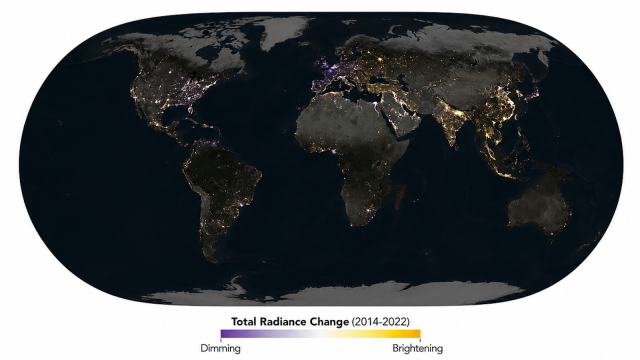
The concept of Earth's night lights as an honest measure of economic activity emerged unintentionally as a byproduct of Cold War satellite technology. In the 1960s, the U.S. Air Force launched weather satellites for tracking cloud cover to aid military planning. By coincidence, these satellites also detected artificial light from human activity, including city lights and gas flares.
After the fall of Communism, nighttime luminosity became a valuable tool, with researchers discovering a strong correlation between light intensity and a country's GDP. This discovery was made by Christopher Elvidge, a NOAA researcher, who noticed that the combined wattage visible in satellite imagery tracked well with countries' economic output.
The connection between night lights and economic activity had an R2 value of 0.97 across 21 countries, indicating a near-perfect fit. However, the potential of this data remained largely untapped for nearly two decades. In 2012, economists J. Vernon Henderson, Adam Storeygard, and David Weil published a paper that transformed Elvidge's discovery into a reliable forecasting and auditing tool.
This breakthrough came after the Visible Infrared Imaging Radiometer Suite (VIIRS) replaced the older DMSP satellite sensors, providing higher resolution imagery. The new "Black Marble" product allowed researchers to measure and analyze nighttime light emission with unprecedented accuracy. To estimate GDP from night light data, researchers follow a five-step process: acquire the data from VIIRS, clean it to remove noise such as moonlight, cloud cover, wildfires, and aurora, measure the radiance of any given area, apply elasticity (the relationship between light change and GDP change), and cross-reference the results with official GDP figures.
In emerging markets with less reliable official data, the elasticity increases to roughly 0.65%. One of the most striking examples of night light data in action is the stark contrast between South Korea and North Korea. South Korea's lights, centered on Seoul, illuminate the entire landscape, while North Korea remains almost entirely dark, with only a single pinprick of light in Pyongyang.
This stark visual representation highlights the significant economic disparity between the two nations. Nighttime light remote sensing (NTL) has since become a valuable tool for fact-checking economic growth, poverty levels, and even the impact of wars. As the field matures, it continues to provide a more accurate and honest picture of global economic activity than any other method.
Written by urgent.news from Big Think's reporting — not their text. Machine-written — may contain errors; check the original before relying on it.