HappyRobot Raises $150 Million At $1.2B To Fix Enterprise AI Agents
Most enterprise AI demos look great in a lab. But when you put them on a real phone call with a freight broker, a pricing dispute, and three systems to The post HappyRobot Raises $150 Million At $1.2B To Fix Enterprise AI Agents appeared first on Ventureburn .
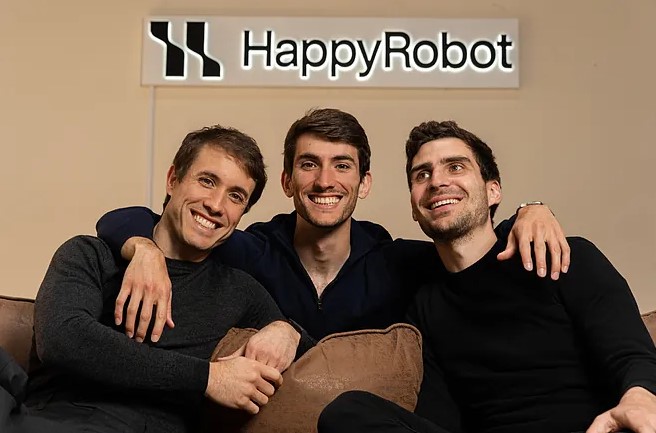
HappyRobot, an enterprise AI startup, has secured a substantial $150 million in Series C funding, bringing its valuation to a staggering $1.2 billion. The investment was led by notable venture capital firms a16z, Base10, and Y Combinator, while strategic partners such as Koch, Orange, Deutsche Telekom’s T.Capital, and Bankinter have joined forces to support the company. This funding round marks a total capital of $200 million raised over 20 months.
Despite impressive numbers, the focus of investors remains on net dollar retention, which stands impressively at over 150%. Additionally, 40% of enterprise AI agents are predicted by Gartner to fail by 2027, not due to inadequate models, but rather due to governance and workflow mishaps. According to data from ChatSee.ai regarding 10,000+ failures, 31.1% stem from resolution or escalation breakdowns, where the agent answered but failed to complete the task or route to a human. Furthermore, just under 10% of failures arise from hallucinations.
HappyRobot's solution lies in its unique approach to building enterprise AI agents, which can handle multi-step workflows across calls, emails, and various systems. This approach avoids the common pitfall of most startups, who typically develop single-task chatbots. The company utilizes six coordinated AI models, each running on Kubernetes across cloud platforms such as AWS, GCP, and Azure.
These models include voice detection, automatic speech recognition, end-of-turn detection, large language model processing, text-to-speech, and proprietary cleanup filters.
To ensure high performance, HappyRobot has implemented a three-layer platform architecture. The top layer consists of tactical agents that handle calls, emails, SMS, WhatsApp, OCR, and browser interactions. The middle layer is the workflow layer, which orchestrates multi-step processes with conditional logic. Finally, the bottom layer is the orchestrating intelligence layer, responsible for shared memory that allows learnings from one agent to benefit all others.
The platform's creators, Thomas Muscher, have described it as "an entire chain: seven phone calls, emails, calculations, then a decision," emphasizing that HappyRobot's solution goes beyond mere task replacement. Instead, it aims to provide an entire chain of operations for enterprises.
Gartner predicts that 40% of enterprise apps will incorporate task-specific agents by the end of 2026, up from 5% last year. As the enterprise agent market is projected to reach $295 billion by 2035, HappyRobot sees its core value in operational depth within multi-step workflows. The company believes that the next wave of enterprise AI success will not hinge on having the smartest model, but rather on its ability to seamlessly handle complex workflows across various platforms.
Written by urgent.news from Ventureburn's reporting — not their text. Machine-written — may contain errors; check the original before relying on it.