‘Fascinating and smart’: Christopher Nolan interview with China podcaster praised for depth
A deep-dive interview between filmmaker Christopher Nolan and Chinese doctoral student podcaster Zhongshu about his new film, The Odyssey, has gone viral worldwide, amassing over 20 million views. Building on his Oscar-winning success with Oppenheimer, Nolan has turned his attention to Homer’s Odyssey, a cornerstone of Western literature. His latest film chronicles the Greek hero Odysseus as he…
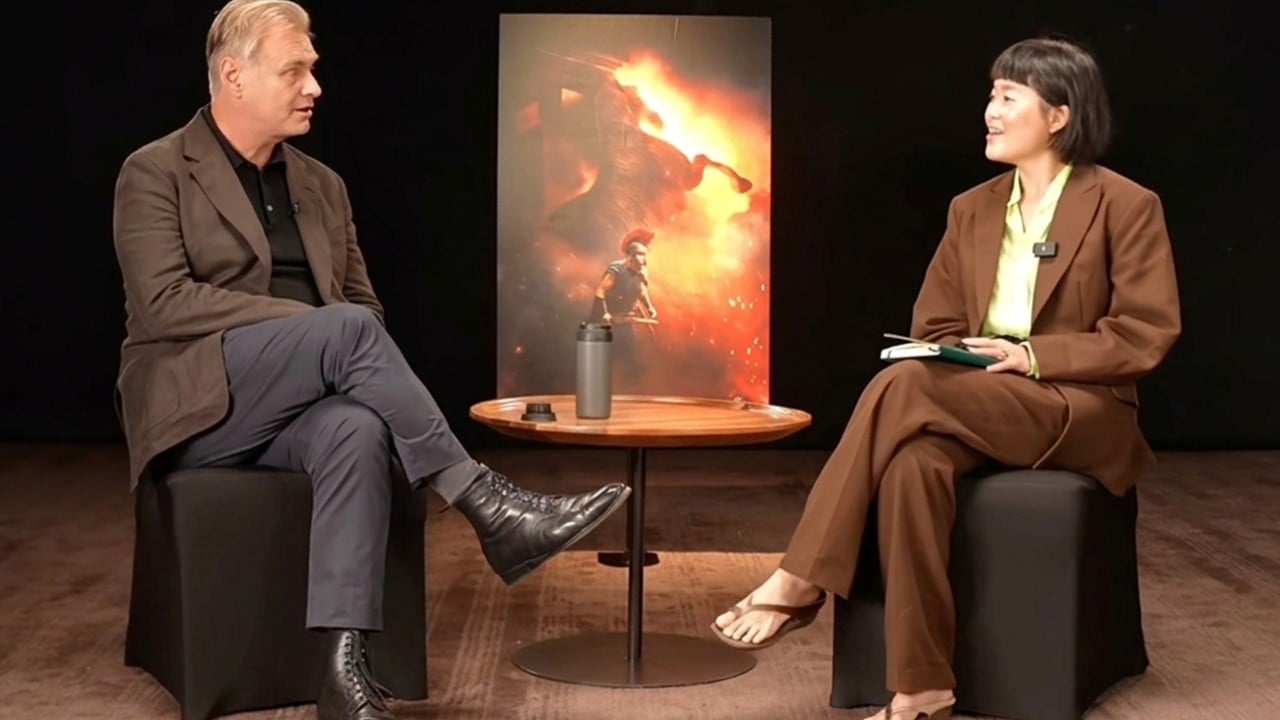
A lengthy conversation between renowned filmmaker Christopher Nolan and Chinese podcaster Zhongshu, delving into The Odyssey, has captivated audiences globally, garnering more than 20 million views. Nolan, celebrated for his Oscar-winning Oppenheimer, has now turned his gaze to Homer’s Odyssey, a timeless Western literary work. The film follows Odysseus’ daunting voyage home to Ithaca after the Trojan War, as his wife and son confront suitors seeking to usurp his throne.
Nolan attended the film's premiere in Beijing on July 30. The subsequent day, he engaged in a 17-minute interview with Zhongshu, a pseudonym for Boston College political philosophy PhD candidate Zhuge Yiyang. Over the course of the dialogue, they examined themes of societal decline, heroism, and modern film criticism. Zhongshu commenced by describing Nolan as “a bard for a civilization at dusk,” asserting that he mirrors Homer’s ability to immortalize figures like Odysseus, Achilles, and Agamemnon.
Nolan echoed this sentiment, noting that both his storytelling and Homer’s epic explore patterns of decay and renewal. He was particularly intrigued by the Bronze Age collapse that forms the basis of Homer’s epic and aimed to incorporate Oppenheimer’s themes of societal decay into The Odyssey. The conversation then shifted to whether Nolan had "Christianized" Odysseus by framing his journey as atonement, a notion absent in Greek culture.
Nolan clarified that his emphasis lay on Xenia, the Greek concept of hospitality depicted in the film as "Zeus’s Law." When strangers might be deemed divine due to this code, mutual respect forms the bedrock of civilization. However, the Trojan horse disrupts this trust, transforming it into a weapon. For Nolan, breaching Xenia serves as a contemporary warning: when respect for others wanes, civilization risks unraveling.
The most circulated moment of the interview saw Zhongshu asking if cinema can still depict greatness when society demands public figures to apologize, reflect, and engage in self-criticism. Nolan responded that filmmakers inherently draw from narrative devices that resonate with audiences while being mindful of the interplay between creative intent and audience interpretation – even when critics subsequently challenge those conventions.
"The fact that the mechanism is identifiable does not invalidate its use," he emphasized. Television personality Geoff Keighley subsequently shared the interview on August 1, dubbing it "fascinating and smart." Zhongshu later mentioned that both Nolan and senior Universal Pictures executives appreciated her inquiries. The interview resonated positively online, with many describing it as "Nolan's best interview," surpassing other promotional coverage focused on the cast and IMAX technology.
Some viewers contrasted the interview's intellectual depth with Hollywood's usual emphasis on celebrity gossip and gaming. A Chinese netizen remarked, "China is not only surpassing the US in technology but also in understanding the West." An Argentine viewer joked: "If Nolan visited here, he would likely only be asked about his taste in dulce de leche, Argentina's iconic caramel spread."
Zhongshu reflected on the interview's popularity, stating, "A truly good interview has become a rare luxury." She expressed that she avoided flattery, gossip, and forced humor, favoring a serious discussion about film and creativity. The global response prompted some American viewers to reflect on anxieties surrounding their own culture and education system.
However, Zhongshu cautioned that the praise could also lead to distortions, as the internet simplified her into a "China lady" or a humble, enigmatic scholar from the East. She lamented on her podcast, "In just 17 minutes, the internet's myriad tribes dissected the interview like a whale, each extracting the segment that resonated most with them."
One Chinese commentator criticized the tendency to replace serious news with shouting matches, while another lamented the internet's failure to democratize knowledge, transforming a valuable resource into a spectacle.
Written by urgent.news from South China Morning Post's reporting — not their text. Machine-written — may contain errors; check the original before relying on it.