刚果河每秒向大西洋注入4万立方米淡水。一项新研究追踪了这些淡水的去向。
研究人员综合运用观测资料与数值模拟,追踪了刚果河淡水羽流的运动轨迹,并指出涡旋在水体输运过程中发挥了重要作用。
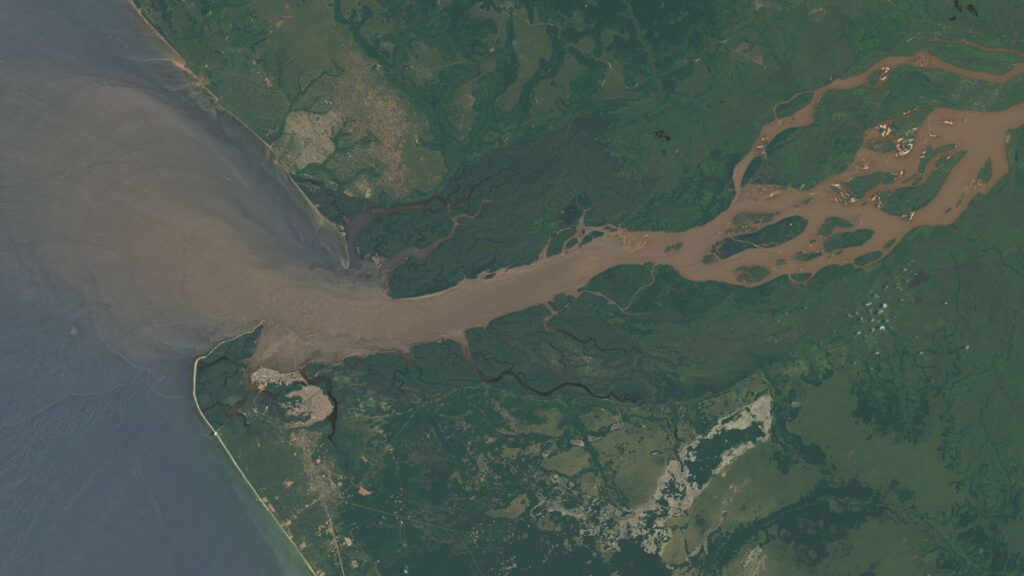
The Congo River, the world's second-largest, currently injects approximately 40,000 cubic meters of freshwater into the Atlantic Ocean every second. A new study follows the journey of this freshwater.
Congo River is one of the largest rivers in the world, with an average flow of 40,000 cubic meters of water per second into the Atlantic Ocean. This enormous flow creates a vast freshwater plume that stretches 800 kilometers. During the rainy season, this plume moves southwestward and may be captured by large-scale rotating ocean currents, known as "mesoscale eddies" that can span hundreds of kilometers. These eddies can carry freshwater hundreds of kilometers offshore from the coastline.
A recent study by Cardot et al. combines model simulations with field data to analyze these mesoscale eddies and the process of freshwater entering the Atlantic Ocean from the Congo River. The research team used a high-resolution ocean circulation model called NEMO (European Ocean Modelling Core Model) with a resolution of 3 kilometers to simulate the river's flow.
The study focuses on the year 2016, as this year offered a wealth of observational data from the PIRATA array in the tropical Atlantic, as well as satellite records of salinity, sea level, and surface currents in the area. Researchers also utilized data gathered by the eOdyn company via Automatic Identification System (AIS) on ships to validate model outputs.
Overall, the model successfully reproduced the spatial extent, geographical location, and seasonal variations of the freshwater plume from the Congo River. During 2016, several mesoscale weather events occurred. One such eddy occurred in March and April, transporting large amounts of freshwater into the ocean. This cyclone formed near the Congo River plume, lasted for 49 days, and grew to a radius of 150 kilometers.
The cyclone carried low-salinity water from the plume's core and carried it offshore to about 200 kilometers away, before gradually dissipating.
Particle tracking experiments traced the origins of the water captured by the eddy, revealing the specific path freshwater takes as it flows from the Congo River to the Atlantic Ocean. By backward tracking over time, researchers found that particles trapped in the eddy's core in April originated from the southern region of the river plume in early March.
This finding suggests that such intermittent processes are the primary drivers of freshwater transport to the ocean, rather than the continuous diffusion of Congo River water. These findings have significant implications for regional ocean circulation, marine ecosystems, and fisheries that depend on these freshwater inputs.
Written by urgent.news from Eos's reporting — not their text. Machine-written — may contain errors; check the original before relying on it.