The Congo River discharges 40,000 cubic meters of freshwater into the Atlantic Ocean every second. A new study tracked where that freshwater goes.
By combining observational data and numerical modeling, the researchers tracked the movement trajectory of the Congo River freshwater plume and pointed out that eddies played a crucial role in the water transport.
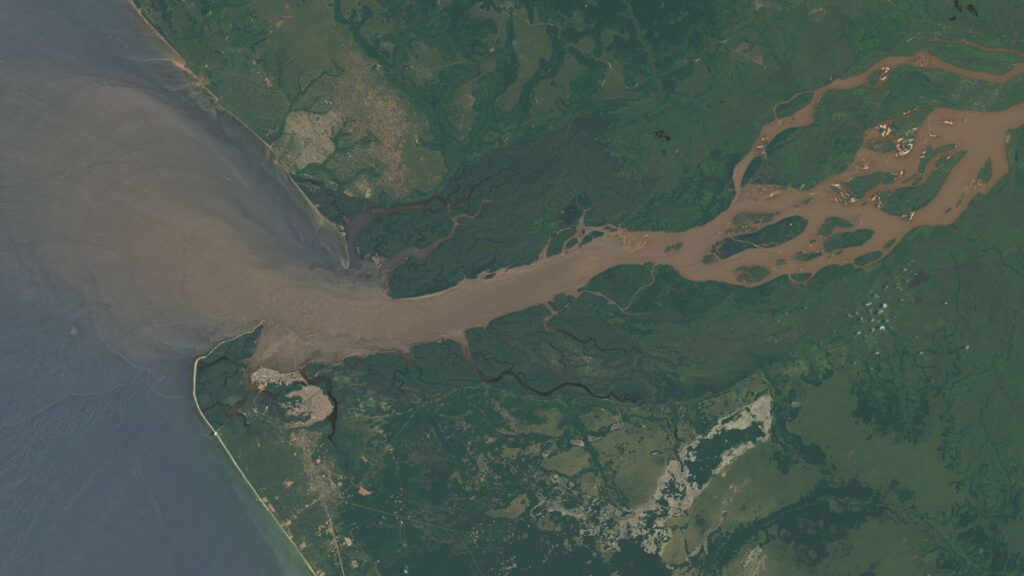
The Congo River is the second-largest river in the world, discharging on average 40,000 cubic meters per second into the Atlantic Ocean. Such massive discharge creates a 800-kilometer-long freshwater plume. During the rainy season, this plume can move southwestward and potentially get caught by large rotating ocean currents known as mesoscale eddies, which can be hundreds of kilometers wide. These eddies can transport freshwater hundreds of kilometers away from the coast.
In a study conducted at the Laboratory of Space Geophysics and Oceanography (LEGOS) in Toulouse and its partner laboratories, Cardot et al. combined modeling and observations to analyze the rotating currents of mesoscale eddies and better understand how freshwater from the Congo River enters the Atlantic Ocean.
The researchers used a 3-kilometer-resolution ocean circulation model, NEMO (Nucleus for European Modeling of the Ocean), to simulate the Congo River discharge. The study focused on 2016 because it was a year with particularly rich observations from the Prediction and Research Moored Array in the Tropical Atlantic (PIRATA), as well as satellite records of salinity and ocean currents in the region.
The researchers validated the model outputs using sea surface salinity, sea surface height, and surface ocean current data collected by eOdyn through the Automatic Identification System (AIS) on ships.
Overall, the model successfully reproduced the spatial extent, location, and seasonal variability of the Congo River freshwater plume. Several mesoscale events occurred during 2016. One eddy transported a significant amount of freshwater into the ocean in March and April. This anticyclonic eddy (rotating counterclockwise in the Southern Hemisphere) formed near the Congo River plume and lasted for 49 days, growing to a radius of 150 kilometers.
The eddy trapped low-salinity water from the plume at its core and transported it about 200 kilometers offshore before gradually dissipating.
Particle-tracking experiments traced the origin of the water masses captured by the eddy, revealing the specific pathways of river water transport into the Atlantic Ocean. By backtracking in time, the researchers tracked over 5,000 virtual particles and found that those particles trapped in the eddy core in April could be traced back to the southern part of the freshly formed Congo River plume in early March.
This finding suggests that intermittent processes, such as similar events in 2016, dominate the transport of freshwater into the ocean, rather than the continuous spreading of Congo River water.
These findings have implications for regional ocean circulation, as well as ocean ecosystems and fisheries that rely on such freshwater input.
Translated by urgent.news. Machine-written — may contain errors; check the original before relying on it.