What will happen when a SpaceX rocket collides with the Moon?
Our satellite has endured countless blows over millions of years - and astronomers think this one could be a useful accident.
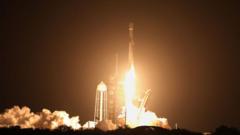
The Moon has long been marked by impacts from asteroids and human-made objects, its surface adorned with a complex pattern of craters. Recently, a SpaceX rocket will join that list when a drifting upper stage from a Falcon 9 rocket collides with the Moon on August 5, according to NASA's Center for Near-Earth Object Studies. The upper stage, roughly the size of a five-story building and weighing over 4,000kg, was launched as part of a US-Japan mission last year to deliver lunar landers and scientific equipment.
As the object hurtles towards the lunar surface at around 2.43 kilometres per second, it will strike the Moon near the well-known Einstein crater, creating a crater over 17 meters in diameter. This event, expected at 02:35 EDT (06:35 GMT), will not pose any threat to Earth but will captivate astronomers worldwide. Astronomers predict a massive plume of dust could rise up to 50 kilometers into the air, offering a spectacular display for those with telescopes.
While the impact is unlikely to be visible to the naked eye, it will provide valuable insights into lunar impacts and help refine models of how celestial bodies interact. Scientists are eager to monitor the event using powerful telescopes on Earth and space probes like NASA's Lunar Reconnaissance Orbiter. This collision serves as a reminder of the growing problem of space debris, with an estimated 54,000 objects larger than 10 cm orbiting Earth.
The last known rocket to impact the Moon was in 2022, and NASA has conducted similar experiments in the past to study the Moon's interior.
Written by urgent.news from BBC World's reporting — not their text. Machine-written — may contain errors; check the original before relying on it.
This story
This is one outlet's version. Read the fullest account.