New HBF spec outlines tech that can give GPUs terabytes of extra memory — Sandisk and SK hynix unveil spec with up to 16-Hi NAND stacks, 3 TB/s bandwidth, UCIe
Sandisk and SK hynix formally introduce HBF specification that promises up to 3 TB/s of bandwidth eventually, though only four companies are currently interested in the technology.
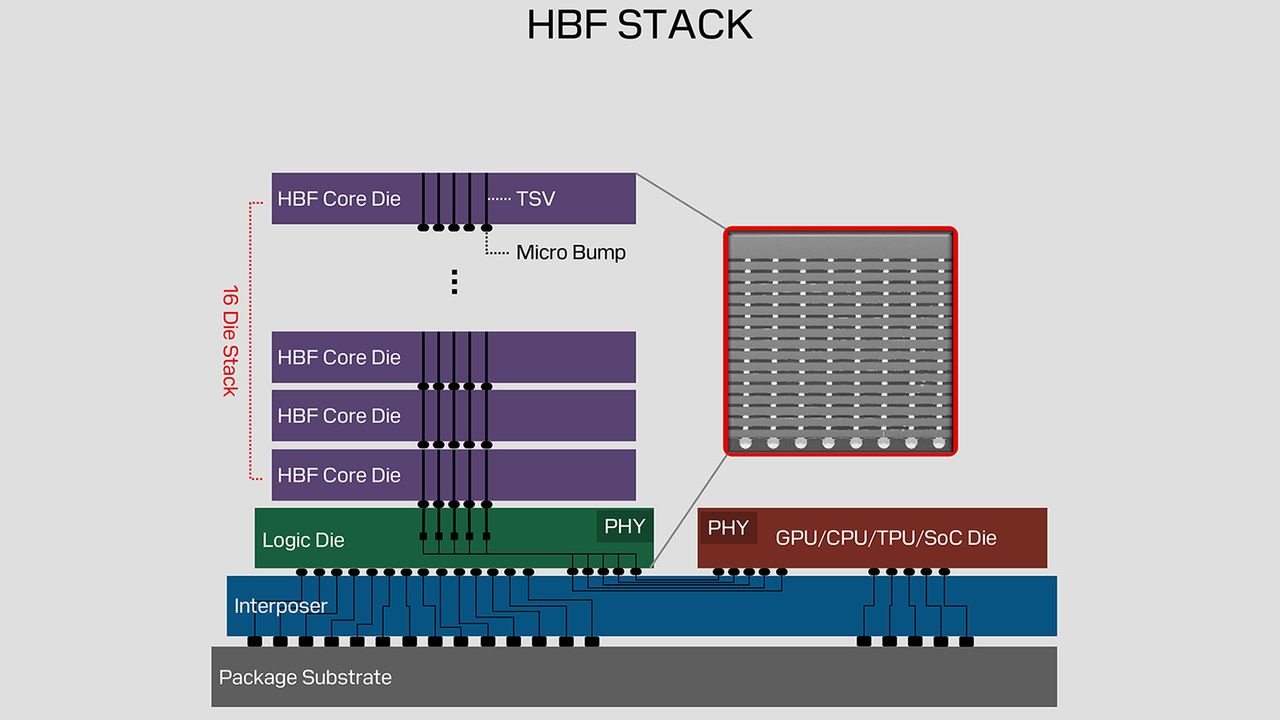
Sandisk and SK hynix have jointly introduced the High Bandwidth Flash (HBF) specification, a storage technology that combines the non-volatility of 3D NAND and the performance of High Bandwidth Memory (HBM). The specification, released through the Open Compute Project, aims to benefit AI inference systems. HBF packages can reach up to 512GB using 8-Hi or 16-Hi NAND die stacks, with bandwidth ranging from 0.4 TB/s to 3.0 TB/s.
The technology is expected to have a multi-year roadmap, with the most capable implementation anticipated to surpass the memory bandwidth of a single HBM4 memory stack. HBF uses UCIe or xPU-HBF standards for integration with heterogeneous computing platforms, and the specification covers electrical and interface characteristics, packaging, reliability guidelines, and software I/O requirements.
Brief written by urgent.news from Tom's Hardware's own syndicated text. Machine-written — may contain errors; check the original before relying on it.