La montaña rusa de la Bolsa coreana atrapa al pequeño inversor
La renta variable surcoreana registró su peor mes desde 2008 en julio. Las dudas sobre el negocio de los chips y la fiebre por los fondos apalancados sacuden el parqué asiático y dejan fuertes pérdidas entre los minoristas
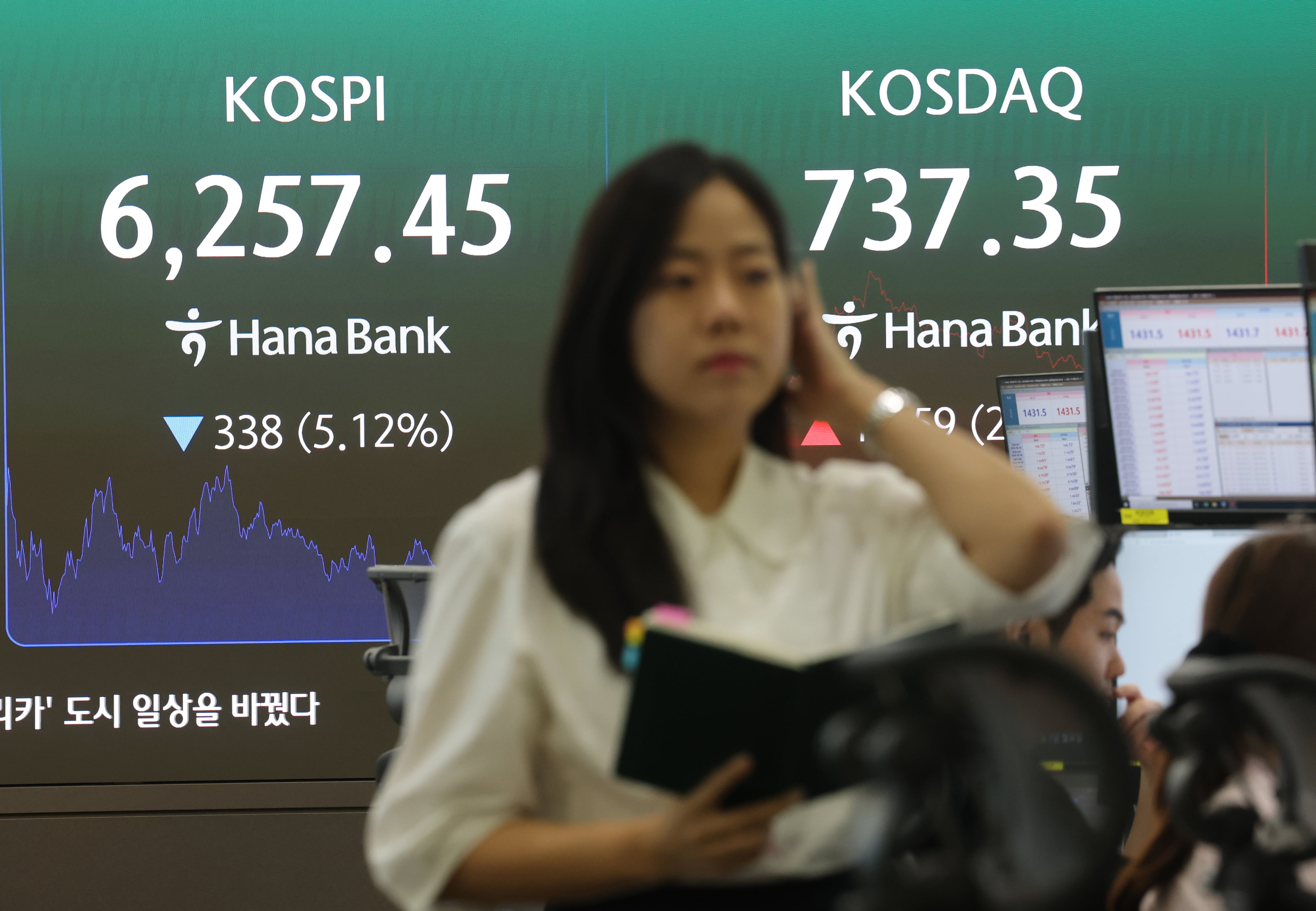
The turbulent South Korean stock market has left many inexperienced investors reeling. After leading gains in major global markets and reaching peaks by late June, the Kospi index suffered its worst month since 2008, falling 22.2% and experiencing violent swings. The magnitude of the drop becomes clearer when compared to the euphoria that preceded it.
Within six months, the Kospi surged 116% by June 22, reaching a historic high before plummeting nearly 39% to 5,594 points by July 30. In just three days, July 28-30, it lost 17.2%. On its final day of the month, it rebounded 17.9%, the largest single-day gain in its history, following positive earnings from Microsoft and Amazon that quelled fears of a halt in investment in artificial intelligence (AI).
However, this surge did not alleviate the drop, and the index still needs to rise 46% to reach new highs. The rollercoaster has caught numerous investors who entered the market when prices were already near peaks. Ahn Ji-young, a 30-year-old newlywed preparing to buy a home, had allocated about 100 million won (€60,800) across South Korean stocks and foreign funds, tracked exchange-traded funds, and other investment vehicles.
By late July, she faced a potential loss of over 40% in her South Korean portfolio. "Everyone says not to put all your eggs in one basket, but they've all broken," she told the South Korean newspaper Metro. "I would like to continue investing, but I no longer have any capital." The catalyst was the decline in Samsung Electronics and SK Hynix, the two major South Korean chip memory manufacturers that had driven the market's rise.
The excitement over AI had lifted their stock prices, but by late June, investors began to doubt their valuations and the sustainability of the demand surge. This uncertainty was compounded by China's development in ultra-fine ultraviolet lithography equipment, which rekindled concerns that memory manufacturers could expand capacity more rapidly.
The successful initial listing of China's CXMT reinforced worries about potential oversupply, while the popularity of cheaper Chinese AI models like Kimi K3 fueled the possibility that applications would require less computational power and fewer advanced memories. Nevertheless, analysts agree that the Chinese threat is currently more relevant for medium-term expectations than for current results.
Doubts about the sector explain the start of the correction, but not its severity. Falls (and also rebounds) were amplified by leveraged exchange-traded funds (ETFs) tied to individual stocks, launched a few weeks earlier and popular among small investors. Josh Gilbert, a market analyst at eToro specializing in Asia-Pacific and the Near East, explains via email that the market's exceptional performance early in the year had created saturation before any problems emerged.
He attributes the initial drop to the revision of valuations and the amplification of effects by leveraged products. "When Samsung and SK Hynix fall simultaneously, the whole market is affected," he concludes. These products were introduced following a reform approved by the South Korean government in April. Previously, ETFs had to include at least ten assets, with no single asset exceeding 30% of the portfolio.
The new rules enabled the creation of funds linked to a single stock, which could double or triple daily performance based on the level of leverage. They began trading on May 27 and, due to capitalization, liquidity, and derivative market depth requirements, only Samsung and SK Hynix qualified as underlying assets. The operation was simple: if a stock gained 10% in a session, a leveraged ETF would rise 20%.
However, it also doubled losses and recalculated the target daily, causing successive oscillations to quickly erode capital. Moreover, these funds rebalanced their exposure by buying when prices rose and selling when they fell, actions that could further reinforce market movements. Gilbert notes that these structures force sales during price declines, triggering another round.
The products found fertile ground for investors, with the number of investment accounts reaching 108.77 million by the end of June, equivalent to over two per capita. Applications for financing stock purchases reached a record 38.63 trillion won (€23,500 million) on June 24, according to the Yonhap news agency. Part of this increase had been built on borrowed money that brokers could liquidate forcefully when losses exceeded certain limits and the guarantees provided to investors were exhausted (margin call in English).
The quest for quick profits led some of these products to become instruments for betting on the market's direction from one session to the next. Seo, a 30-year-old unemployed individual, told the JoongAng Ilbo daily that after losing money on a leveraged product tied to SK Hynix, he interpreted the decline as an opportunity, selling the gold he had at home and buying more shares.
"With so much time spent watching stock screens, I feel that investment has taken over my life," he reported.
Written by urgent.news from El Pais Economia's reporting — not their text. Machine-written — it may contain errors, so check the original before relying on it.