The rollercoaster of the Korean Stock Exchange catches the small investor
South Korean equities recorded their worst month since 2008 in July. Doubts about the chip business and a craze for leveraged funds are shaking the Asian stock exchange and leaving heavy losses among retailers.
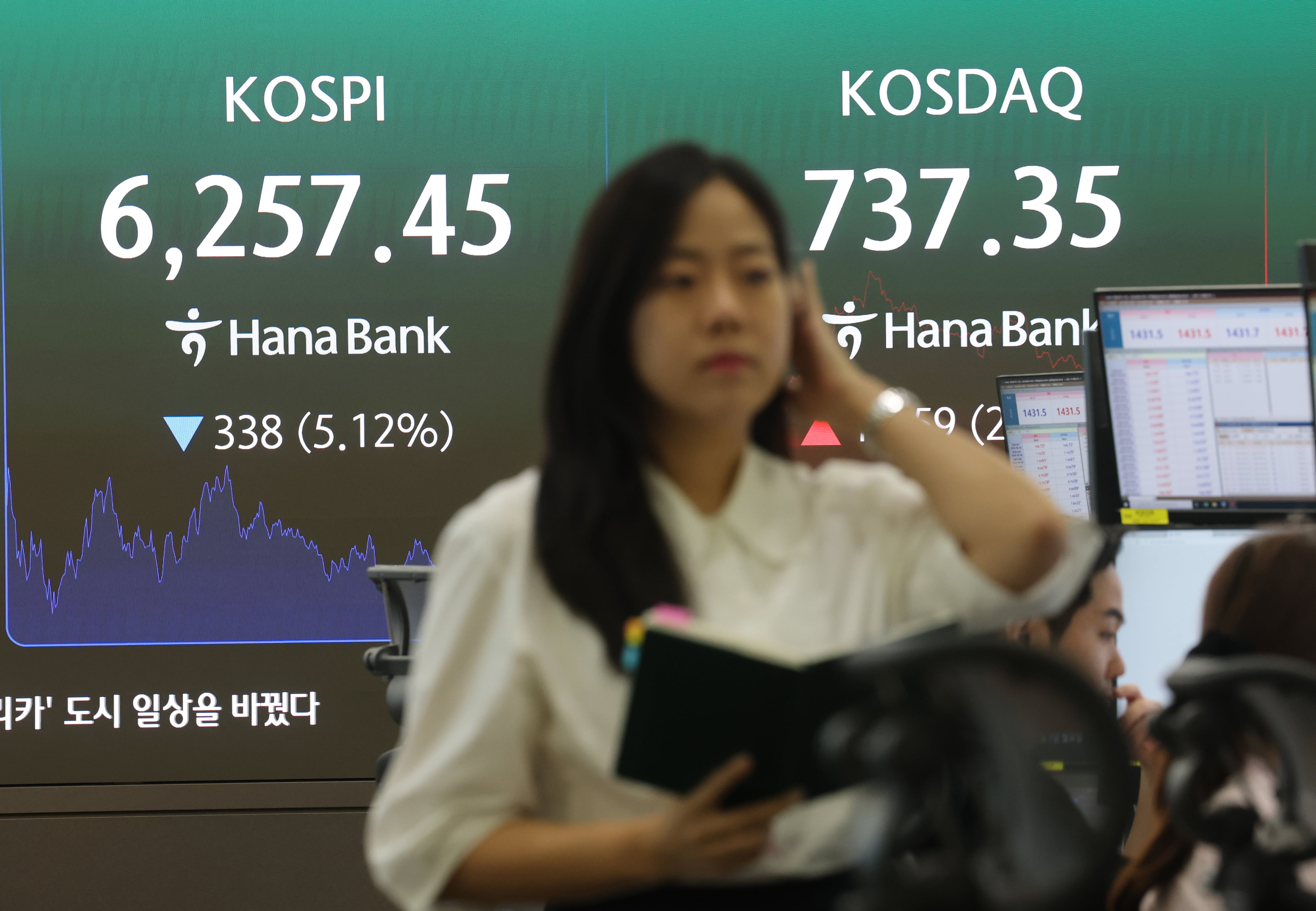
July has shattered the confidence that dominated the South Korea stock market during the first half of the year. After leading the gains of major global markets and reaching highs at the end of June, the Kospi has recorded its worst month since 2008, with a 22.2% decline and violent swings. The magnitude of the Korean stock market's fall is better understood by comparing it to the euphoria that preceded it.
In less than six months, until June 22, when it reached an all-time high, the Kospi appreciated by 116%. From that level, it plummeted by almost 39%, to 5,594 points on July 30. Only between July 28 and 30, it lost 17.2%. And on the last trading day of the month, it rebounded by 17.9%, the largest daily gain in its history, after Microsoft and Amazon's results alleviated fears of a slowdown in artificial intelligence (AI) investment.
A rebound that has served to moderate the punishment, but not to overcome it: the stock index still needs to rise by 46% to reach its highs.
The rollercoaster has hit numerous investors who entered the market when prices were already near highs. Ahn Ji-young, a thirty-something newlywed who was preparing to buy a home, had distributed around 100 million won (60,800 euros) among South Korean and foreign stocks, exchange-traded funds, and other investment vehicles. By the end of July, she had accumulated latent losses of over 40% just in her Korean portfolio.
"As they say, don't put all your eggs in one basket, so I spread them out among several, but they've all broken," she told the South Korean newspaper Metro. "I'd like to keep buying, but I don't have any capital left," she said.
The trigger was the fall of Samsung Electronics and SK Hynix, the two large South Korean memory chip manufacturers that had driven the market's rise until then. Enthusiasm for AI had driven up their prices, but at the end of June, investors began to doubt their valuations and the duration of the demand boom. As their combined weight represented more than half of the Kospi, their decline dragged down the entire index.
To these doubts was added the advancement of the industry in China. The development of deep ultraviolet lithography equipment in the Asian giant revived fears that its memory manufacturers could expand their capacity more quickly. The successful stock market debut of China's CXMT reinforced concerns about a future oversupply, while the popularity of cheaper Chinese AI models, such as Kimi K3, fueled the possibility that applications would require less computing power and fewer advanced memories.
However, analysts agree that the Chinese threat is, for now, more relevant to medium-term expectations than to current results. Doubts about the sector explain the start of the correction, but not its virulence. The falls (and also the rebounds) were amplified by leveraged exchange-traded funds (ETFs) on individual stocks, introduced a few weeks earlier and very popular among small investors.
"Korea was the best-performing market in the world at the beginning of the year, so positioning was saturated before any problems arose," explains Josh Gilbert, market analyst at eToro, specializing in Asia-Pacific and the Middle East. In his opinion, the review of valuations caused the initial fall, and the leverage multiplied its effects. "When Samsung and SK Hynix fall simultaneously, the entire market is affected," he concludes.
These products were introduced after a reform approved by the South Korean government in April. Until then, ETFs had to contain at least ten securities, and none could exceed 30% of the portfolio. The new rules allowed the creation of funds linked to a single stock, which can double or triple their daily evolution depending on the degree of leverage.
They began to be traded on May 27, and due to capitalization, liquidity, and derivatives market depth requirements, Samsung and SK Hynix were the only securities that served as underlying assets. The operation was simple: if a stock gains 10% in a session, a bullish ETF with a leverage of two times rises by 20%. But it also doubled the losses and recalculated the target every day, so successive oscillations could quickly erode capital.
Additionally, these funds adjust their exposure by buying when the price rises and selling when it falls, operations that can reinforce the market movement. "These structures force sales in the face of falling prices, triggering the next round," Gilbert notes.
The products found fertile ground. The number of active investment accounts reached 108.77 million at the end of June, equivalent to more than two per inhabitant, although one person can have multiple accounts. Requests to finance stock purchases reached a record 38.63 trillion won (23,500 million euros) on June 24, according to the Yonhap agency.
Part of the rise had been built, therefore, with borrowed money that brokers could forcibly liquidate when losses exceeded certain limits and the guarantees provided by investors were exhausted (margin call). The search for quick profits led some of these products to become instruments for betting on the direction of the market from one session to another.
Seo, a 30-year-old man actively looking for employment, told the JoongAng Ilbo newspaper that, after losing money with a leveraged product on SK Hynix, he interpreted the collapse as an opportunity, sold the gold he had at home, and bought more stocks. "From constantly looking at the quotes screen, I feel like investment has taken over my life," he said.
Translated by urgent.news from El Pais Economia's report; automated translation may contain errors. Machine-written — it may contain errors, so check the original before relying on it.