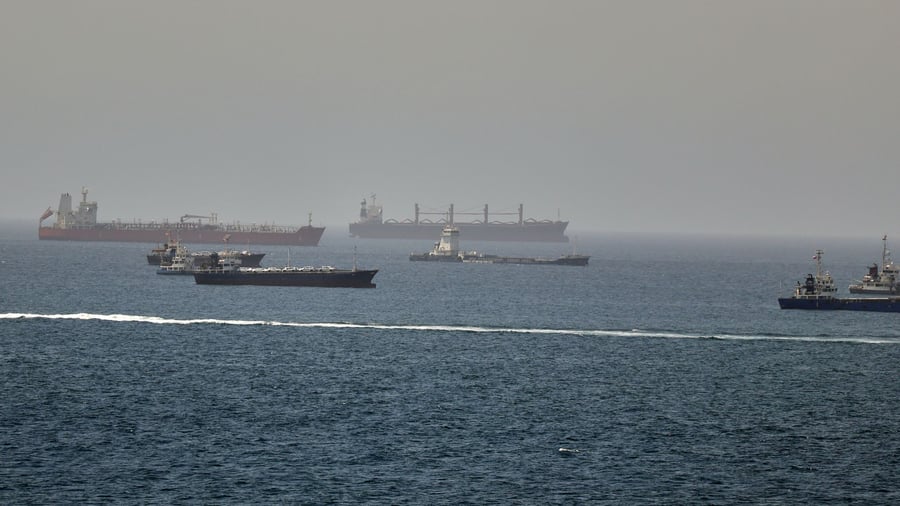
Iran war: cargo ship attacked in Strait of Hormuz
The strait is a bottleneck for the export of oil and gas from the Persian Gulf states. Some ships venture to pass along the Omani coast - much to Tehran's dismay.
After US President Donald Trump threatened Iran, diplomatic efforts to resolve the conflict continue. The spokesman for Qatar's Foreign Ministry, Madsjid al-Ansari, stated in Doha's capital that diplomatic efforts are ongoing and already far advanced. A solution for ship traffic in the Hormuz Strait is expected soon, according to reports from Qatar and the US.
Meanwhile, talks between Israel and Lebanon continued in Rome to implement their security agreement. A deal on ship traffic could come soon, with US Treasury Secretary Scott Bessent expecting reopening of the strait today or tomorrow. "We are in talks with the Iranians, and I think there is a chance we can reach an agreement today or tomorrow to open the strait," he said in a CNBC interview.
When asked about a possible toll, he said he assumed a free passage. US Secretary of State Marco Rubio spoke to reporters in Washington about talks on the strait between Iran and Oman, involving the US. Progress has been made, but a final agreement has not yet been reached. "We hope this will happen very soon," al-Ansari said. As of Monday, US President Trump had again threatened Teheran to reach a negotiation solution, first opening the vital strait between Iran and Oman, then resolving the dispute over Iran's nuclear program.
Iran floated the idea of a roundabout for ships navigating the crucial strait: in conjunction with Oman, cargo ships could enter the Hormuz Strait through Iranian waters from the north and use a southern route via Omani waters for the return journey. The "New York Times" reported, citing Iranian and US officials, on the plans. The US Defense Department, however, has reservations about the solution.
On the one hand, it almost amounts to capitulation to Iran; on the other hand, many Iranian mines are still being moved into Omani waters, requiring coordination with the Islamic Republic. The solution would allow Iran to control which ships enter the Persian Gulf and potentially prevent warships from passing. It would also enable the Islamic Republic to collect passage fees.
Ship traffic in the Middle East remains under pressure despite lack of direct attacks between the US and Iran. A cargo ship was attacked in the Hormuz Strait overnight on Tuesday, 37 kilometers northeast of the Omani town of Al Chasab. The UK Maritime Safety Authority reported the incident, noting no damage or injuries to the ship.
Despite continuing tensions in the region, only nine ships passed through the Hormuz Strait on Monday, according to information from data provider Kpler. The past week, about 16 ships on average passed through the strait daily. Attacks by Houthi militia from Yemen allied with Iran on Saudi Arabia have also affected shipping through the Bab al-Mandab strait at the Red Sea's exit.
Further talks between Israel and Lebanon have resumed in Rome to implement their security agreement, with an underground tunnel system of Hezbollah set to be a central issue. The US is mediating in the conflict, aiming to achieve a solution independent of Iran, which is a key ally of Hezbollah. Hezbollah itself is not involved in the talks.
The most recent framework agreement includes the withdrawal of Israeli troops from southern Lebanon and disarming Hezbollah, both of which have not yet been implemented. The seventh round of talks is set to continue until Thursday.
Written by urgent.news from Handelsblatt's reporting — not their text. Machine-written — may contain errors; check the original before relying on it.
This story
This is one outlet's version. Read the fullest account.
- Middle East: Waiting for an agreement on the Strait of Hormuz handelsblatt.com