Automotive industry: Profit crisis of premium manufacturers: Hyundai overtakes BMW and Mercedes
The dependence on combustion engines in China is proving disastrous for BMW and Mercedes. A Handelsblatt analysis shows that the manufacturers are only doing better than the competition in one market.
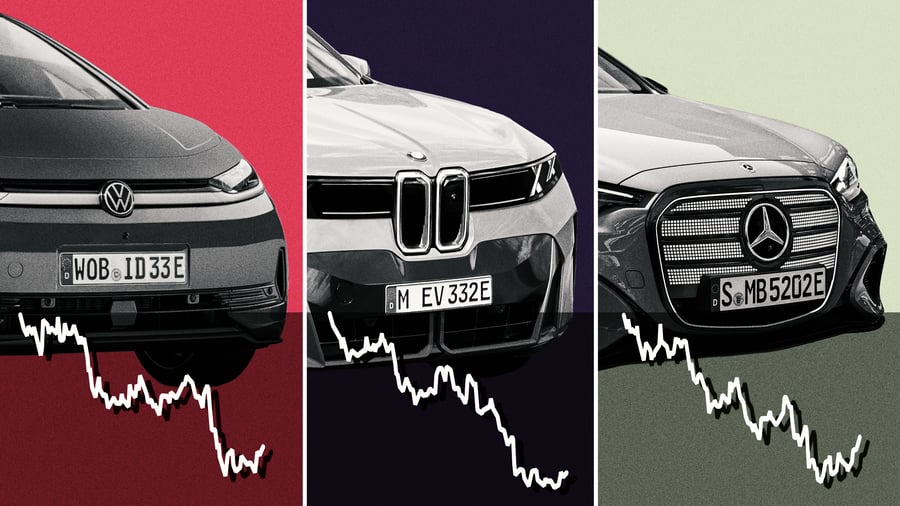
Record high on the German stock market and the country's most important industry is not playing a role - on the contrary: BMW, Mercedes-Benz and VW have so far been among the biggest losers of the stock market year. This is because German premium car manufacturers are struggling with a profitability crisis. The profit margins in the core passenger car business of BMW and Mercedes fell in the first half of the year, in some cases below the level of mass car manufacturers, as a Handelsblatt analysis of the current balance sheets shows.
Mercedes' car division achieved an unadjusted profit margin before interest and taxes (EBIT) of only 1.9% in the first half of the year - after 14.3% in the same period three years ago. The Munich-based rival BMW achieved 3.6%, compared to 10.6% in 2023. Both are below the Volkswagen Group (4.1%), but also below foreign volume manufacturers such as GM from the United States (3.8%) and South Korean competitor Hyundai-Kia (5.4%).
The unadjusted profit margins have been adjusted for restructuring costs. This key figure makes the passenger car business more comparable. "It's as if the house suddenly stood on its head. Premium manufacturers earning less than volume providers paints a shocking picture of the industry," says Matthias Schmidt from the analysis and consulting company of the same name.
The German premium brands have a special role in the international auto industry. There are practically no comparable premium brands abroad, with such high production numbers. BMW and Mercedes each produce around two million vehicles per year. Thanks to years of high profit margins, a large proportion of these could be manufactured in Germany.
The crisis of the premium brands from Munich and Sindelfingen is therefore dealing another severe blow to the German automotive location, which is already weakened by the VW crisis. German manufacturers suffer more than their competitors in China.
Double-digit profit margins are not so long ago, but they seem like a different time. Especially during and at the end of the Corona pandemic, VW, BMW, and Mercedes reported record results, also because they prioritized margin-rich vehicles in production due to chip and parts shortages and were able to achieve higher profits.
However, since 2023, it has been practically only downhill. VW CEO Oliver Blume speaks of an "industry crisis". He argues that this is primarily due to the market decline in China. BMW CEO Milan Nedeljkovic and Mercedes CEO Ola Källenius argue almost identically.
An analysis by Handelsblatt based on registration numbers in China confirms the diagnosis of the German auto bosses. However, the numbers also show that German manufacturers have developed worse in China than the market.
For example, Mercedes recorded a decline in registrations of almost 27% in the first half of the year, according to figures from data provider Marklines. The total registrations in China fell by around 19% in the same period.
At the VW Group with the brands VW, Jetta, Audi, Skoda, and Porsche, the decline is almost 26%. BMW fares best with a decline of around 20%.
A toxic combination is proving disastrous for German automakers: they are over-proportionally dependent on the Chinese car market. However, German manufacturers make money in the world's largest electric car market practically only with their combustion engines.
The market shares in the electric car business in China are vanishingly small: Mercedes achieves 0.2%, BMW 0.4%, and VW 0.6%. At the same time, the combustion engine market is collapsing due to high fuel prices, and with it, the profits of the corporations in their formerly most profitable market.
Alternative regions in Asia that could compensate for the losses in China, at least partially, have not been explored by German manufacturers. This leaves deeper traces in the balance sheets of German automakers than their competitors.
While the EBIT of GM and Hyundai-Kia has fallen by around 40% since 2023, it is 56% at Volkswagen, 70% at BMW, and almost 90% at Mercedes. In the first half of 2023, the Swabians still achieved an EBIT of €8 billion in the car business. This year it was only €858 million.
Only the parent company of Opel, Stellantis, records an even higher profit decline.
The industry is responding with restructuring: BMW is reportedly cutting 8,000 jobs worldwide. Mercedes has reportedly cut around 5,500 jobs through a voluntary program and is now further tightening its austerity measures, especially here in Germany.
And Volkswagen could cut a total of around 100,000 jobs worldwide, the future of four plants in Germany remains uncertain.
In the automotive industry, managers had hoped for an improvement this year. However, after the first half of the year, it is becoming clear that the crisis will continue to worsen in view of the shrinking market in China and rising production costs and uncertainties due to the Iran war.
BMW had already warned of lower profits weeks ago, Mercedes and Volkswagen cut their sales forecasts with the half-year figures.
Localization more difficult for BMW and Mercedes
The manufacturers are trying to counteract this with increasing localization: they produce vehicles specifically for the Chinese market in order to keep up with their competitors in terms of speed, costs, and efficiency.
From the perspective of Daniel Schwarz, auto analyst at Bankhaus Metzler, premium manufacturers find localization in China more difficult than volume manufacturers.
"Mercedes and BMW can hardly afford to develop a completely adapted car for the local market due to the production numbers in China," says Schwarz. Solutions are difficult, he says.
One approach is offered by VW's premium subsidiary Audi, which is developing vehicles specifically for the Chinese market.
Translated by urgent.news. Machine-written — may contain errors; check the original before relying on it.