Ariston Group: Despite the crash in the German heating market: Italian group does not regret billion gamble
The Ariston Group has made its biggest acquisition in Germany. This has not yet paid off. Despite a drop in profits and stock market frustration, Group CEO Merloni is sticking to his course.
Italian entrepreneur Paolo Merloni is pleased about the new German heating law: "Finally, the phase of uncertainty that weighed on the industry in Europe has come to an end," he says. His company, the Ariston Group, is one of the world's largest manufacturers of climate technology, heating systems, and hot water systems. The German market, with its sales potential, has become crucial for the company.
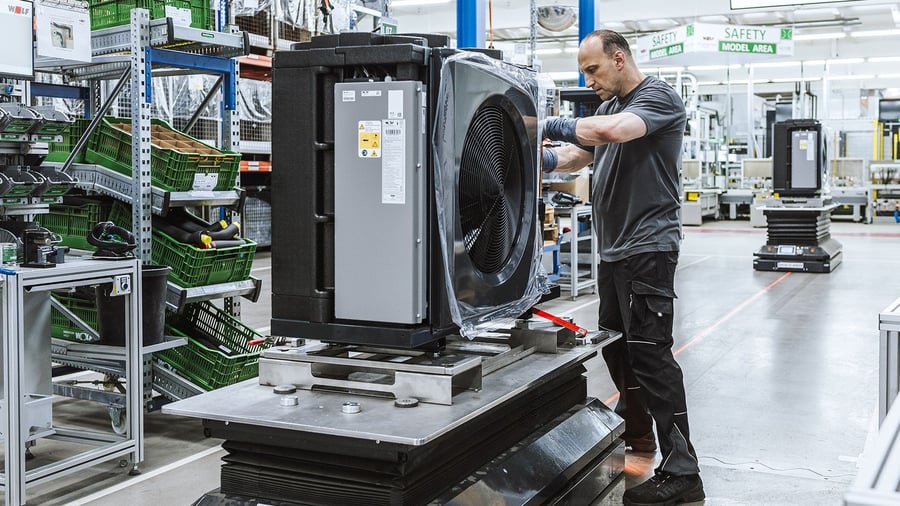
Just around four years ago, the group had closed the largest deal in its company history, paying one billion euros and its own shares for the German Centrotec Climate Systems (CCS). CCS includes brands such as heat pump manufacturer Wolf and room ventilation producer Brink. Now, Germany is the largest sales market for the group, with almost 20 percent.
Stabilization at a low level
German climate policy does influence the success of the Italian company. An example is the heating law by former Economics Minister Robert Habeck, focusing on renewable energies and heat pumps. Merloni criticizes in retrospect: "You can't switch an entire country to heat pumps within three years." With logistics, production, and employee training, the heating suppliers couldn't keep up.
So, after the unnaturally strong growth, the inevitable crash followed: In 2023, 1.3 million heating systems were sold on the German heating market, the most in 28 years, but the market collapsed by 47 percent in the following year. In Merloni's opinion, CCS has only recovered from this today, two years later. However, the figures for 2025 indicate a stabilization at a lower level.
The Ariston Group achieved sales of 2.8 billion euros and a profit of 132 million euros in the past year, roughly the same profit as before the CCS acquisition. In the previous year, 2024, sales had shrunk to 2.63 billion euros, and profit had plummeted to 2.5 million euros - an enormous drop of 98.7 percent. Merloni could look critically at his billion-dollar investment in Germany today.
Nevertheless, the company boss says he is "extremely satisfied." This is also shown by his willingness to continue investing in the Mainburg location, the seat of the Wolf brand: in logistics, a new production line, and in research and training.
Since the beginning of the year, the "Campus Wolf" has been located in Mainburg on 4,500 square meters, distributed over three floors. Research on the topic of energy transition and specialists are to be trained there. The group has invested 60 million euros in the location in the past four years, according to its own information.
The Ariston Group boss is convinced that the German market will continue to grow strongly in the future. "The existing heating systems are outdated and need to be replaced. In addition, the requirements for energy efficiency and the reduction of CO2 emissions have increased," he justifies his assessment, which he must also defend against critics.
"Tie deep roots in Italy and Germany"
They accuse Merloni of having emphasized the opportunities in the German market before the CCS purchase. However, the group has not been able to benefit from this so far. Unrealistic expectations were also raised during the IPO in 2021: At that time, the shares were sold at 10.25 euros per share, and today they are trading at around 3.50 euros.
Despite this poor performance, Mediobanca analyst Alessandro Tortora judges positively: "Ariston is a full-range provider in the heating and thermal comfort sector that can accompany market development." This applies, thanks to strategic acquisitions, especially to Germany and Italy, the two highest-turnover markets of the group.
This fits exactly with the company's self-image. "We are a European company with deep roots in Italy and Germany," says Merloni. The Ariston Group was founded in 1930 by Merloni's grandfather Aristide in the Italian Marche region as a scale manufacturer and expanded its business into other sectors. Son Francesco finally took over the sanitary technology.
Paolo Merloni, the current Executive Chairman, began his career in the company in 1995. Today, Europe is still the most important market for the group, with around 18 percent of sales in Germany and 15 percent in Italy.
In both countries, the company employs over 5,000 people, and 12,000 worldwide. Following the partnership with CCS, another important deal in Italy took place this year: At the beginning of July, the Ariston Group completed the purchase of the Italian Riello Group, active in the field of climate comfort and combustion technologies, for around 320 million euros.
Analyst Tortora believes that the Riello acquisition is "strategically very sensible" for the Italian market, especially since the brand is considered iconic in Italy.
Moreover, the market access has been consolidated because it depends on the installers. About half a year earlier, the Ariston Group had also entered into a joint venture with the US climate company Lennox. The Italian company is now present in 40 countries with pre-sales outlets and customer service, and in 19 also with production units.
Worldwide, the company achieves sales of almost three billion euros after integrating Riello. Merloni continues to look confidently into the future. However, he wishes for one thing from politics: predictable framework conditions. "We believe that the market should develop on the basis of long-term guidelines, without abrupt changes of course," he says.
Translated by urgent.news. Machine-written — may contain errors; check the original before relying on it.