Threat to oil tankers in Middle East worst since start of Iran war, analysts say
Fresh attacks on alternative shipping routes have left tankers facing an increasingly complex situation, analysts say.
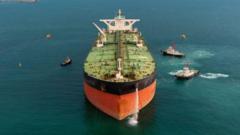
The threat to oil tankers sailing in the Middle East is at its most severe since the beginning of Iran's war, according to experts. This warning comes after a series of attacks on vessels in the Red Sea, which many tankers have been using as an alternative route following Iran's closure of the Strait of Hormuz. Iran has denied claims of negotiating with the US regarding the reopening of the strait, but has stated that they are discussing with Oman to secure the shipping lane.
Matthew Wright, an analyst at ship-tracking firm Kpler, stated that the current situation represents the worst period for oil trade since the crisis began. The number of ships passing through the Strait of Hormuz has plummeted from over 100 per day before the war to just eight on Sunday and 11 on Saturday. Only about 20% of the world's oil and gas passes through the strait, which was previously a crucial trade route.
Many ships have been "going dark" when crossing the Strait of Hormuz, turning off their transponders to avoid detection. Most of the oil from Saudi Arabia has been passing through the Red Sea, but a recent wave of attacks by Yemen's Houthi fighters on Saudi tankers has further heightened the risks. The Houthi militia declared a blockade on Saudi Arabia's Red Sea ports on July 20 and has carried out several attacks on ships in the past week.
This situation is exacerbating the existing issues in the Strait of Hormuz, which is already constraining oil flows. Tim Wilkins, the managing director of Intertanko, a trade body representing tanker owners, stated that the industry is now facing a worsening and increasingly complex security situation. The number of commodity vessels passing through the Bab el-Mandeb strait, a crucial route leading into the Red Sea, has dropped to about 50% of pre-attack levels.
The Houthi threat is primarily focused on Saudi shipping, but the overall number of vessels passing through remains around 50% of pre-attack levels. Hapag-Lloyd, a global shipping giant, reported that some of its vessels are still passing through the Red Sea, but they are closely monitoring the situation and willing to adjust their network if circumstances change. However, restoring normal cargo flows would likely take three to four months due to suspended services and ships being redeployed elsewhere.
Despite discussions with Oman, Iran has not signaled an imminent deal to reopen the strait, maintaining restrictions as long as US "aggression" persists. The fighting has brought the shipping industry back to square one, with Oxfam analyst Peter Sand describing the current situation as "really troubling times with no clarity and no change of fortunes within sight."
Written by urgent.news from BBC Business's reporting — not their text. Machine-written — may contain errors; check the original before relying on it.
This story
This is one outlet's version. Read the fullest account.