Peter Sloterdijk: "Globalization was the last golden age of liberalism"
In the interview, the philosopher talks about the new world trade order, the end of liberalism – and explains why tech companies could become losers of their own disruption.
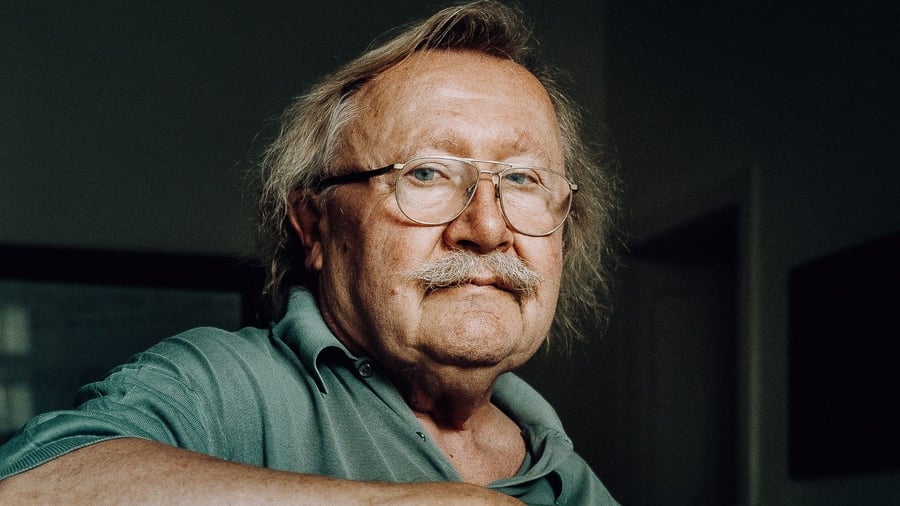
A village in the southern French department of Drôme, where the region slowly transitions into Provence. Peter Sloterdijk, 78, inhabits a country house there in the summer, somewhere far in the hinterland. No sea, no jet set, no palm trees. Instead, hills, lavender, and sunflowers. Only occasionally does he want to - the doctors! the mail! - briefly visit his Berlin apartment.
And sometimes go to Paris to stretch his legs. He finds relaxation particularly necessary this summer. Times are turbulent. And that also affects a philosopher who often likes to rub against current conditions. Recently, he gave a much-noticed speech at the Paris Pantheon. There, where France's great figures rest, he was supposed to - one of the few Germans to be honored - deal with the work of Victor Hugo.
Sloterdijk managed to send a signal of unshakeable confidence, even in these complicated times, which culminated in the sentence: "Even in a world of setbacks, a realistic politics of humanity will patiently prevail." Before that, he had been on a three-month discussion tour in Germany. In March, he had published his new book, which was fully up-to-date.
It's about the tendency of modern rulers to be brutal princes. Sloterdijk had read Niccolò Machiavelli for this, whose work "The Prince" serves as a standard for all malicious leadership figures and those who want to become one. The Suhrkamp Verlag, which has been publishing Sloterdijk since time immemorial, put a picture of Donald Trump on the cover - dressed in Renaissance clothing like the ruthless Pope's son Cesare Borgia.
The book is selling correspondingly well - more than 35,000 times, says Sloterdijk, as he receives the Handelsblatt in his French home. People had many questions for him. Some that surprised him too. "It's highly selectively read," says Sloterdijk, sitting at the living room table of the house. Outside, the mistral is blowing and making a terrace conversation impossible.
"That people only allow those pages from a manageable book to enter their minds that match their mindset," he finds astonishing. However, it's not surprising that Germans seek out Sloterdijk, the intellectual, as a reference point for forming opinions. Since the death of Hans Magnus Enzensberger and Jürgen Habermas, the German debate has been lacking an intellectual center of power, recently lamented "Die Zeit".
Apart from Sloterdijk, there's not much left. The much-discussed topic of his prince book, the rise of authoritarianism around the world, has already been mentally filed away by Sloterdijk. Even the domestic political turmoil of the Federal Republic seems far away here in the French summer exile; Sloterdijk waves off questions about Merz or even Klingbeil.
Too small, he signals. Basically, however, he will come back to it in the conversation. Actually, though, he's driven by the big themes of our time: the weakness of democracy, the comeback of geopolitics, and the impact of the AI revolution. He wants to find answers to these questions, but unlike so many observers these days, he never succumbs to the temptation of an apocalyptic worldview.
Read the interview with Peter Sloterdijk here.
Mr. Sloterdijk, the Germans are currently experiencing grave reasons for uncertainty: the German business model is eroding, the belief in the previous peace order is dwindling, artificial intelligence is redefining the relationship between work and capital, and rising authoritarian tendencies are threatening democracies. Which of the problems would you prioritize?
One must first realize that the narrative streams that have been flowing from the end of World War I to the present have strongly shaped local identities. In view of the war defeat, it was also about a traumatic legacy from the start. Does this seriousness still exist today?
It was a very deep incision when, on November 11, 1918, the capitulation document was signed on French soil, while the republic was proclaimed in Berlin. Most Germans had not seen a single enemy soldier on their home soil; for them, the defeat was still hard to imagine. The "stab-in-the-back legend" could build on this embarrassment, according to which mutinous sailors in Kiel and other rebels had cheated the country out of the near victory.
This absurd core was spun into fascist threads. Denial of defeat is the stuff of which fascism is made. A narrative of this kind has been transferred to the German economy: workers and entrepreneurs feel cheated out of the fruits of their own efforts because German combustion engine cars, machines, or chemicals are no longer in such high demand globally.
In the economy, especially among older workers, psychopolitical explosive material is accumulating. One inevitably thinks of Friedrich Dürrenmatt: "The world is a powder factory in which smoking is not prohibited." And through the new right, there are sufficient candidates in most Western countries who walk through the factory with the glowing cigarette.
In these circles, proto-fascist material is still at work. Through narratives filled with resentment, they rewind the spool. What would be a suitable means for the political center to counter-steer?
Politicians today would have to demonstrate more psychopolitical basic knowledge. But that is not part of their equipment. What do you base this on specifically?
Don't forget the dilemma of immigration. It shows that what is necessary is also impossible. After decades of hesitation, we have officially acknowledged that we are an immigration country. Now it turns out that one cannot easily immigrate into the trauma of the locals and the guilt complexes of a collective. So, we suddenly have cheerful Holocaust ignorers who...
Translated by urgent.news. Machine-written — may contain errors; check the original before relying on it.