Künstliche Intelligenz: „Diebstahl geistigen Eigentums“: Wie China und die USA um die KI-Vorherrschaft kämpfen
Der Wettbewerb um die besseren KI-Modelle ist ins Zentrum des geopolitischen Machtkampfs zwischen China und den USA gerückt – und er betrifft auch Europa.
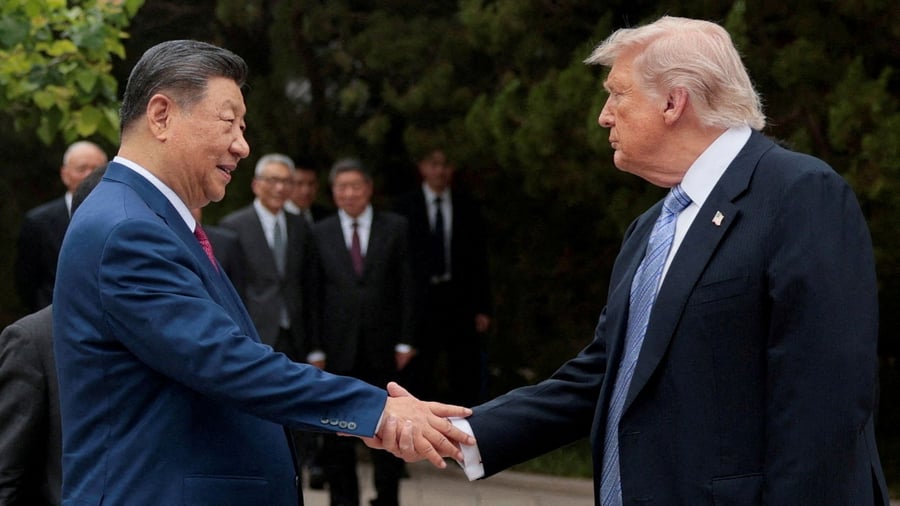
In late May, a notable scene unfolded at the White House as US President Donald Trump was about to sign a government directive on Artificial Intelligence (AI) regulation. However, at the last moment, Trump called off the signing, declining to put his signature on the document. He cited concerns that the US's technological lead over China and other countries could be jeopardized.
This directive aimed to regulate AI and prevent it from hindering the industry's development, a warning echoed by several Chinese AI companies such as Alibaba and Moonshot, which had recently unveiled powerful language models that could rival leading US providers like Anthropic and OpenAI. Despite US efforts to curb China's technological progress with export restrictions on powerful chips from Nvidia, the gap in AI advancement had reportedly narrowed in just a few weeks, according to AI experts Ryan Fedasiuk and Satvik Pendyala from the American Enterprise Institute.
The competition for AI supremacy has become a focal point in the geopolitical struggle between China and the US, with Europe lagging behind due to insufficient development of high-performance models. Most AI models originate from these two nations, leaving Europe dependent on US or Chinese systems. In response, numerous developers worldwide have increasingly turned to "made in China" AI solutions, which are often more accessible and affordable than US alternatives. This trend benefits China's government, which seeks to challenge US technological dominance.
Chinese President Xi Jinping emphasized the importance of global cooperation on AI development during the opening of the World AI Conference in Shanghai in mid-July. He urged the participating governments from the global South to recognize that AI development should not be a solitary endeavor for any single country. Following Xi's initiative, 29 countries, including Brazil, Indonesia, Kazakhstan, Pakistan, and Russia, signed an agreement to form the World Organization for AI Coordination (WAICO), aiming to influence global AI regulation and standardization.
China wants to create a platform to shape the global AI ecosystem, promoting AI that is "safe and controllable."
Written by urgent.news from Handelsblatt's reporting — not their text. Machine-written — may contain errors; check the original before relying on it.