Artificial Intelligence: "Theft of intellectual property": How China and the US are fighting for AI supremacy
The competition for the better AI models has moved to the center of the geopolitical power struggle between China and the USA - and it also affects Europe.
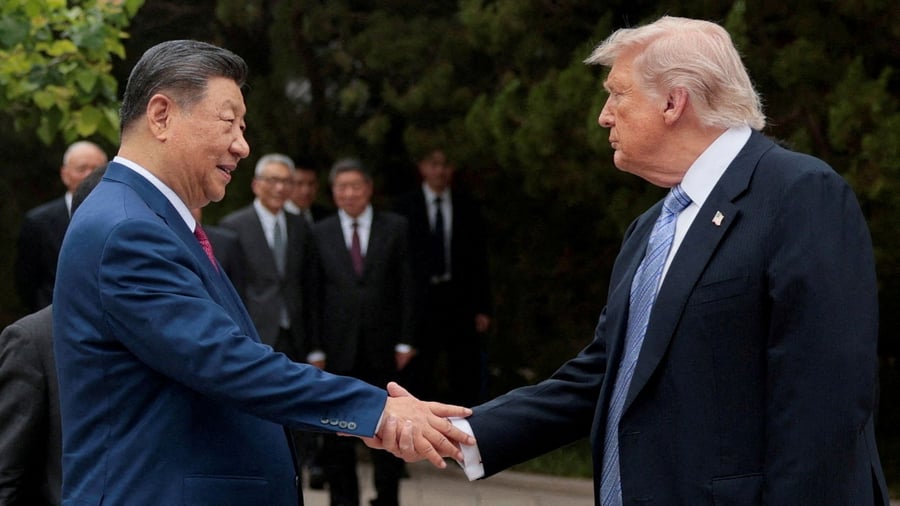
At the end of May, a remarkable scene unfolded at the White House. US President Donald Trump wanted to sign one of his numerous executive directives, with which he has largely bypassed Congress since taking office. The date had already been announced - it was supposed to be about the regulation of artificial intelligence (AI). But at the last minute, Trump pulled back: the appointment was canceled, and the signature did not happen.
As a justification, Trump said: "We're ahead of China, we're ahead of everyone else, and I don't want to do anything that could jeopardize this lead." The planned regulation would only hinder the industry in its development, he warned. Several Chinese AI companies, such as Alibaba and the start-up Moonshot, have presented large language models in recent weeks that can at least partially keep up with the leading US providers Anthropic and OpenAI.
This is despite the fact that the US wanted to slow down China's technological progress with export restrictions on the most powerful chips from the US manufacturer Nvidia. The gap has "closed to approximately a few weeks," analyze AI experts Ryan Fedasiuk and Satvik Pendyala from the US think tank American Enterprise Institute.
China's AI successes call into question US containment strategy The competition for supremacy in AI has moved to the center of the geopolitical power struggle between China and the US - and it also affects Europe. This is because 90 percent of AI models come from these two countries. Europe has fallen behind: because European companies have developed too few high-performance models themselves, the continent is dependent on systems from the US or the People's Republic.
In recent years, the US has passed bipartisan restrictions aimed at slowing down China's progress - apparently with little success. This is all the more true since Chinese AI models are often freely accessible and cheaper than the US competition. Developers worldwide are therefore increasingly turning to AI "made in China." This is entirely in the interest of the Chinese leadership, which wants to challenge the technological dominance of the US.
The strategic importance that Beijing attaches to this issue was also shown by the keynote speech by President Xi Jinping at the opening of the World AI Conference in mid-July in Shanghai. "The development of AI should not be a solo effort by a single country," he emphasized. The message was primarily aimed at the government representatives from the global south who were present.
On China's initiative, 29 countries - including Brazil, Indonesia, Kazakhstan, Pakistan, and Russia - had signed a letter of intent to establish the World Organization for AI Coordination (WAICO) just before that. China wants to create a platform to influence the global regulation and standard-setting for AI. AI must be "safe and controllable," Xi said.
The global popularity of Chinese open-source models offers "a unique opportunity to bind the international community to China's AI ecosystem," writes Kendra Schaefer from the US consultancy Trivium, one of the leading experts on Chinese technology. While Xi wants to make China's AI models accessible to other countries, he is betting on autonomy in his own country and systematically reducing dependence on foreign technology.
Also, as a lesson from the US export restrictions on high-tech chips, the leadership is investing a high double-digit billion amount in building up a domestic chip industry. AI at the center of the geopolitical power struggle For Beijing and Washington, it's about technological supremacy, but also about national security. This is because advanced AI models can spot IT security gaps at high speed.
This was shown, for example, by a pilot project at the browser developer Mozilla: With the model Mythos developed by Anthropic, the team reportedly discovered more security gaps within a month than previously in a whole year. Such findings can be used to close vulnerabilities. However, they can also be misused by hostile states or criminals to exploit security gaps.
This fuels concerns about attacks on military and other critical infrastructures, such as energy supply or the financial system. In June, the US government had temporarily blocked access to the leading US AI model Fable 5 from Anthropic for users outside the US. In the meantime, it is available again, but with restrictions. According to a Reuters investigation from early August, Chinese military researchers are using the leading US AI models to train domestic AI systems and expand China's defense capabilities.
However, the growing spread of high-performance, freely accessible Chinese AI models has also triggered a controversial debate in the US - both in the tech industry and in the White House. While Anthropic and OpenAI demand restrictions on freely accessible AI from China, numerous international and US tech companies warn against excessive restrictions.
US corporations have an advantage Despite the recent Chinese AI successes, experts see US companies ahead of their Chinese competitors in at least three areas for the time being: access to capital, computing power, and high-performance chips. In the analysis by the American Enterprise Institute, it is stated that the chip ecosystem led by the US is still the dominant provider of computing power.
The US is also ahead when it comes to data centers: according to an analysis by Stanford University, it had 5427 data centers in 2025, while China had 449. However, the huge buildings are increasingly facing criticism due to their high water and electricity consumption.
Translated by urgent.news. Machine-written — may contain errors; check the original before relying on it.