Interstellar Travel: the Birth of Fusion Drives
During the Space Age and Cold War, fusion-powered spacecraft systems were investigated as a possible means of reaching another star system within a human lifetime. Many of the proposed ideas are still on the table today, waiting for future advancements to make them realizable.
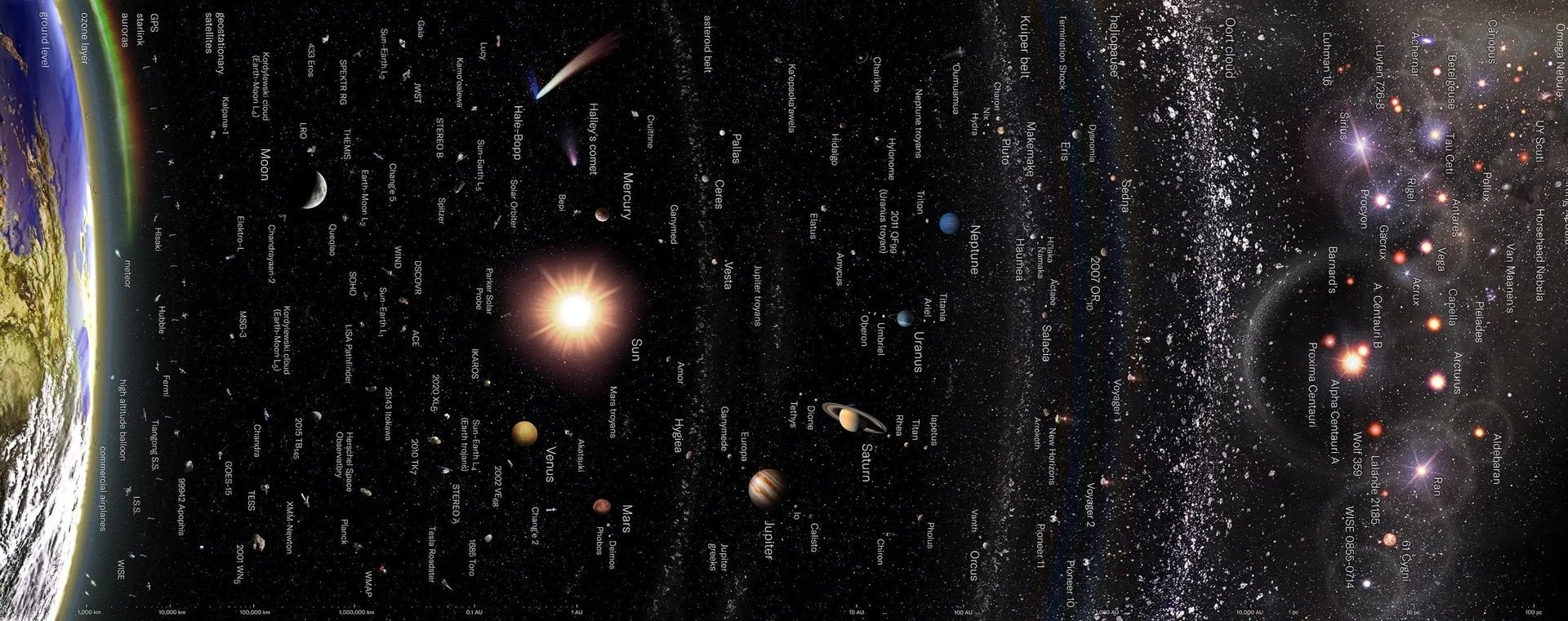
Interstellar travel concepts began to take shape during the Space Age, a time of intense competition between superpowers reflected in rocketry advancements. This period saw the development of two main categories of nuclear propulsion: Nuclear Pulse Propulsion (NPP) and Nuclear Thermal Propulsion (NTP), as well as Nuclear Electric Propulsion (NEC).
Fusion propulsion concepts also emerged, with two main approaches: Magnetic Confinement Fusion (MCF) and Inertial Confinement Fusion (ICF). Fusion systems were projected to achieve specific impulse (Isp) values between 10,000 and 1,000,000 seconds, resulting in exhaust velocities of around 98,067 m/s and 9,806,650 m/s. This could theoretically enable a fusion-powered spacecraft to reach Proxima Centauri in approximately 130 years.
However, these ideas came with significant challenges, particularly in terms of cost and feasibility.
Physicist Robert Bussard made an enduring contribution to the field by proposing the Bussard Ramjet in 1960. This spacecraft would utilize a scoop to gather neutral hydrogen from the surrounding medium and compress it to achieve fusion, generating thrust without the need for propellant. The Bussard Ramjet offers the advantage of not requiring any propellant transport, resulting in a smaller and lighter spacecraft.
However, its potential velocity is limited by the amount of hydrogen available for scooping, as well as the problem of drag. The British Interplanetary Society's Project Daedalus, conducted between 1973 and 1978, aimed to develop an Inertial Confinement Fusion (ICF) spacecraft within the constraints of existing or near-future technology.
Written by urgent.news from Universe Today's reporting — not their text. Machine-written — may contain errors; check the original before relying on it.