Himmelsschauspiel mit Zugabe: Totale Sonnenfinsternis in Spanien steht bevor
Totale Sonnenfinsternisse zählen zu den eindrucksvollsten astronomischen Ereignissen. Früher blickten Menschen voller Furcht nach oben, wenn der Mond die Sonne verschlang. Nun reisen Touristen an.
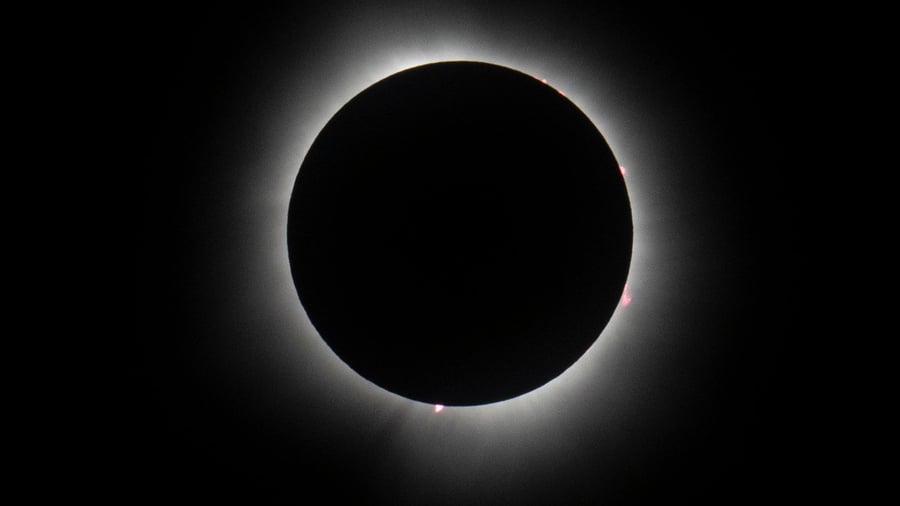
On August 12, millions of people across Europe, including Spain and Germany, will witness a unique celestial spectacle: a total solar eclipse. In Germany, the sun will be partially obscured by the moon, covering approximately 85 to 90 percent of its surface. The strongest coverage is expected in the southwest, where Freiburg will see about 90 percent.
Following the eclipse, a spectacular display of meteors is expected, with up to 100 shooting stars per hour. This meteor shower, known as the Perseids, is expected to peak in the early hours of the night between August 12 and August 13. The best viewing times are from midnight to 4 a.m.
In Germany, the partial solar eclipse begins in the northeast, reaching Greifswald at around 19:12 and reaching Munich at 19:23. The peak of the eclipse is expected between 20:05 and 20:15. The eclipse ends with sunset around 21:00. The partial solar eclipse is visible across much of Europe, North America, and West Africa. For optimal viewing, it is recommended to observe the eclipse from an elevated position with a clear northwest or west view, using eclipse glasses.
Numerous astronomical institutions in Germany will offer observation opportunities during the "Long Night of Astronomy," including live broadcasts from Spain. After the eclipse, observers can look forward to another celestial event: the Perseids meteor shower, which is expected to peak during the night of August 12 to August 13.
The total solar eclipse will start in northern Siberia, where the sun is just above the horizon at midnight. In Germany, the eclipse will begin around 19:00. The moon’s shadow moves over northern Siberia, across the eastern part of Greenland and the western islands, and finally reaches northern Spain, a portion of Portugal, and then crosses the Iberian Peninsula and the Balearic Islands.
The total darkness of the eclipse ends in the Mediterranean Sea around 20:30. The longest total eclipse will be observed approximately 100 kilometers west of the Icelandic coast.
For those who wish to watch the total solar eclipse from the comfort of their home, the European Space Agency (ESA) will provide a live stream of the event, featuring explanations from Harald Lesch. The broadcast will be available on 3sat from 20:15 to 21:00.
A solar eclipse occurs when the moon aligns directly between the sun and the earth, casting its shadow on the earth. In Germany, the moon will only cover a portion of the sun, creating a partial solar eclipse. The core shadow, where the sun is completely covered, is much smaller, resulting in a partial eclipse. This phenomenon is an astronomical coincidence, as the sun's diameter is about 400 times larger than the moon's but is also about 400 times farther away from the earth, making them appear roughly the same size from our perspective.
However, slight variations in the moon’s orbit can cause differences in apparent size. If the moon is slightly farther from the earth during a total eclipse, it may appear too small to completely cover the sun, resulting in a ring-shaped eclipse known as an annular eclipse.
Total solar eclipses occur when the moon is in the same direction as the sun as seen from the earth, which only happens during a new moon. However, due to the moon’s orbit being slightly tilted five degrees relative to the earth’s orbit around the sun, the moon usually passes above or below the sun, resulting in fewer solar eclipses every two to five years.
The core shadow, which brings total darkness to the earth, is typically very narrow, around 200 kilometers in diameter. Thus, total solar eclipses are visible to a small area of the earth at any given time, with the last total solar eclipse visible from Germany occurring on August 11, 1999. The next total solar eclipse will not occur until September 3, 2081.
Written by urgent.news from Handelsblatt's reporting — not their text. Machine-written — may contain errors; check the original before relying on it.