Heavenly spectacle with encore: Total solar eclipse in Spain is ahead
Total solar eclipses are among the most impressive astronomical events. In the past, people looked up in fear when the moon devoured the sun. Now tourists are traveling in.
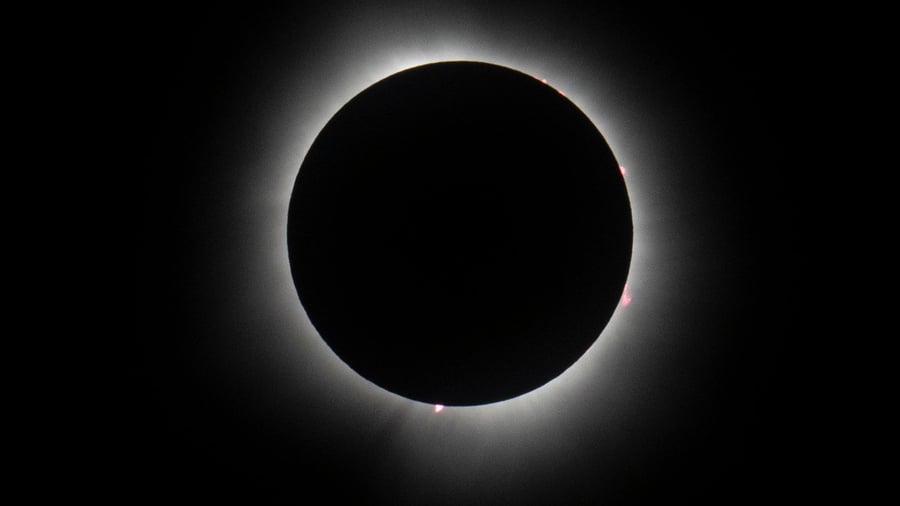
Several million people can experience a very special celestial spectacle in Europe on August 12: a total solar eclipse will completely darken a strip across Spain, among other places. In Germany, the sun will also be covered by the moon, but only to around 85 to 90 percent. The strongest coverage will be in the far southwest, with 90 percent in Freiburg. A special treat will be offered by the sky shortly afterwards with a large meteor shower.
Where and when is the solar eclipse visible in Germany?
In Germany, the partial solar eclipse will start in the northeast - it will reach Greifswald at 19:12 and Munich at 19:23. Its maximum is expected between 20:05 and 20:15. The spectacle will end in all of Germany with sunset around 21:00.
The partial solar eclipse can be seen in most of Europe, but also in North America and West Africa. Since the sun will be relatively low on the horizon during the eclipse in Germany, it is best seen from a vantage point with a clear view to the northwest or west - a solar eclipse glasses are required. Many astronomical facilities throughout Germany will also invite visitors to observe the solar eclipse in Germany as part of the "Long Night of Astronomy", some will also offer live broadcasts from Spain.
After the solar eclipse, sky gazers can look forward to another event: the Perseid meteor shower will peak on the night of August 12-13, with up to 100 meteors per hour expected. The best viewing times are from 23:00 to 04:00.
Where can the total solar eclipse be seen?
The total solar eclipse will start in northern Siberia, where the sun is still visible as a midnight sun on the horizon. In Germany, it will be around 19:00. The shadow of the moon will pass over the North Pole, eastern Greenland, and western Iceland. It will reach northern Spain, a corner of Portugal, and then cross the Iberian Peninsula and the Balearic Islands. The total eclipse will end shortly after 20:30 in the Mediterranean.
The longest totality will be 2 minutes and 18 seconds, approximately 100 kilometers west of the Icelandic coast, off the island group of Hvallátur. Those who want to watch the total solar eclipse from their living room can follow it via livestream from the European Space Agency (ESA). With commentary from Harald Lesch, it will also be broadcast live on TerraX's "Solar Eclipse over Mallorca" (20:15 to 21:00 on 3sat).
How does a solar eclipse occur?
During a solar eclipse, the moon stands on a line between the sun and the earth, so that the shadow of the moon falls on the earth. On August 12, Germany will only be in the partial shadow, so the moon will only cover part of the sun. In the umbra, however, the sun is completely covered by the moon, and the solar eclipse is total.
It is an astronomical coincidence that the moon can cover the sun almost exactly. The diameter of the sun is about 400 times larger than that of the moon, but it is also about 400 times farther away from the earth than the moon. Therefore, both celestial bodies appear to be roughly the same size when viewed from earth.
However, there are slight deviations. Since the moon's orbit around the earth is not exactly circular but slightly elliptical, the distance between the earth and the moon varies. Therefore, the apparent size of the moon in the sky also changes. If the moon is at a lunar eclipse when it is near the farthest point of its orbit, it is slightly too small to completely cover the sun's disk. The result is a ring-shaped eclipse instead of a total one.
How common are solar eclipses?
For an eclipse to occur, the moon must be in the same direction as the sun when viewed from earth, so it must be a new moon. However, not every new moon results in a solar eclipse. The moon's orbit is tilted at an angle of about five degrees relative to the earth's orbit.
Therefore, the moon usually passes above or below the sun. Solar eclipses occur only two to five times a year. However, the umbra does not always fall on the earth. A total solar eclipse occurs only about every 18 months - somewhere on earth. At a specific location, they are very rare, since the umbra has a diameter of at most 200 kilometers.
The last total solar eclipse visible from Germany was on August 11, 1999, and the next one will not be until September 3, 2081. A curiosity: another total solar eclipse will be visible in Spain on August 2 next year, but only in the far south. On January 26, 2028, there will be an annular solar eclipse in Spain.
What can be seen during a total solar eclipse?
When the totality begins, the brightness decreases suddenly - within seconds, it becomes like late twilight, and some bright stars and planets appear in the sky. The Venus is particularly noticeable, shining at a distance of about 45 degrees to the left of the sun.
Around the black disk of the sun darkened by the moon, the corona shines during the totality. This corona is the outer atmosphere of the sun, extremely thinly distributed gas that shines due to its high temperature of over a million degrees. This temperature is surprisingly high, since the surface of the sun is only 6,000 degrees Celsius hot.
A slightly elevated location is favorable for observation, as one can see the shadow of the moon approaching from there. It moves at a speed of about 1 kilometer per second.
Translated by urgent.news. Machine-written — may contain errors; check the original before relying on it.