The James Webb Telescope Is Changing Astronomers’ Understanding of the Ancient Cosmos
From how galaxies form to the beginnings of the universe, the images from the space telescope are giving cosmologists new data to explore—and theories to build out.
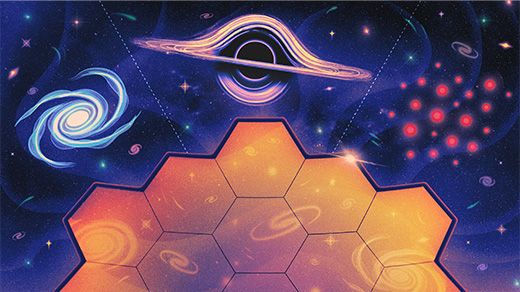
In recent years, astronomers have been captivated by the myriad of mysteries unveiled by the James Webb Space Telescope (JWST). One such enigma is the prevalence of "little red dots" in images captured by the telescope, which have never been observed before its launch in 2022. These objects have been dated to approximately 650 million years after the Big Bang, hinting at a profound transformation in our understanding of the early universe.
Another perplexing find is the presence of black holes that far surpass the expected mass for their age. These ancient behemoths challenge existing theories regarding their rapid growth within the first billion years post the Big Bang. Profound questions arise as to how these colossal black holes could have formed and expanded so quickly under the prevailing astrophysical principles.
The universe as revealed by JWST appears to defy the current comprehension of astrophysics, prompting scientists to reevaluate their understanding of the cosmos. This shift in perspective has fostered a flurry of new theories, each offering intriguing solutions to these cosmic conundrums. However, the validity of these theories remains a matter of conjecture, with further investigation required to ascertain their veracity.
Among the potential explanations for the enigmatic little red dots, one possibility is the existence of black hole stars, an entirely novel object class. These hypothetical entities would comprise a dense gas cloud enveloping a black hole, emitting light akin to a stellar atmosphere. While this scenario provides a plausible explanation, it necessitates additional scrutiny to validate the theory conclusively.
Further scrutiny of these cosmic phenomena is ongoing as researchers worldwide delve into the wealth of data provided by JWST. Each new discovery inches us closer to a more comprehensive understanding of the universe's origins, with the intricate puzzle of its beginnings gradually taking shape.
Written by urgent.news from Wired Science's reporting — not their text. Machine-written — may contain errors; check the original before relying on it.
This story
This is one outlet's version. Read the fullest account.