The James Webb Telescope Is Changing Astronomers’ Understanding of the Ancient Cosmos
From how galaxies form to the beginnings of the universe, the images from the space telescope are giving cosmologists new data to explore—and theories to build out.
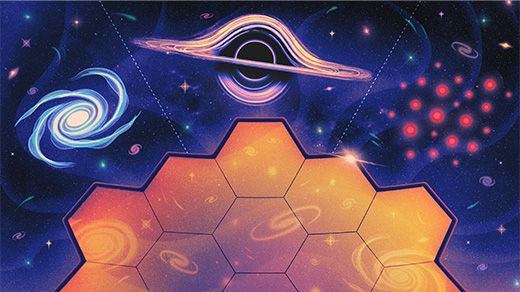
The James Webb Space Telescope (JWST) has been revealing astonishing mysteries about the early universe since its launch in 2022. One intriguing discovery are the so-called "little red dots," objects that have puzzled astronomers since they appeared in JWST images. These dots are believed to be ancient black holes that formed just 650 million years after the Big Bang, defying traditional theories on how such massive objects could have grown so quickly.
Another stunning find from JWST is the existence of supermassive black holes that appeared to be far too large for their age, suggesting they underwent rapid growth in the early cosmos. These contradictions have prompted scientists to develop numerous theories to explain the unexpected observations, but determining which theories accurately represent reality remains an ongoing challenge.
One theory proposes that the little red dots could be black holes enveloped in thick gas, possibly representing a novel object called a black hole star. However, recent analyses of the light emitted by these dots have challenged this hypothesis, indicating that alternative explanations may be needed.
Moreover, researchers are grappling with the question of how such enormous black holes could have formed so early in the universe's history. The standard formation process through the collapse of massive stars appears insufficient to account for the rapid growth observed. Instead, scientists are investigating potential shortcuts, such as the super-Eddington accretion scenario, where gas can funnel into black holes at rates beyond the Eddington limit, or the direct collapse mechanism, which could create black holes with seeds weighing up to 10,000 times the mass of the sun.
These investigations by astronomers worldwide are gradually piecing together a clearer picture of the universe's beginnings, with JWST continually shedding light on ancient cosmic enigmas.
Written by urgent.news from Wired's reporting — not their text. Machine-written — may contain errors; check the original before relying on it.