Chinese rocket scientists find ‘most effective’ way to nuke a doomsday asteroid
Chinese researchers believe they may have found the most effective way to destroy or deflect a large, Earth-threatening asteroid – by burying a nuclear bomb beneath its surface and exploding it. The idea is to first slam a metal penetrator into the asteroid, digging a deep hole. A second spacecraft would then drop a nuclear bomb into the hole and blow it up, according to a team led by researchers…
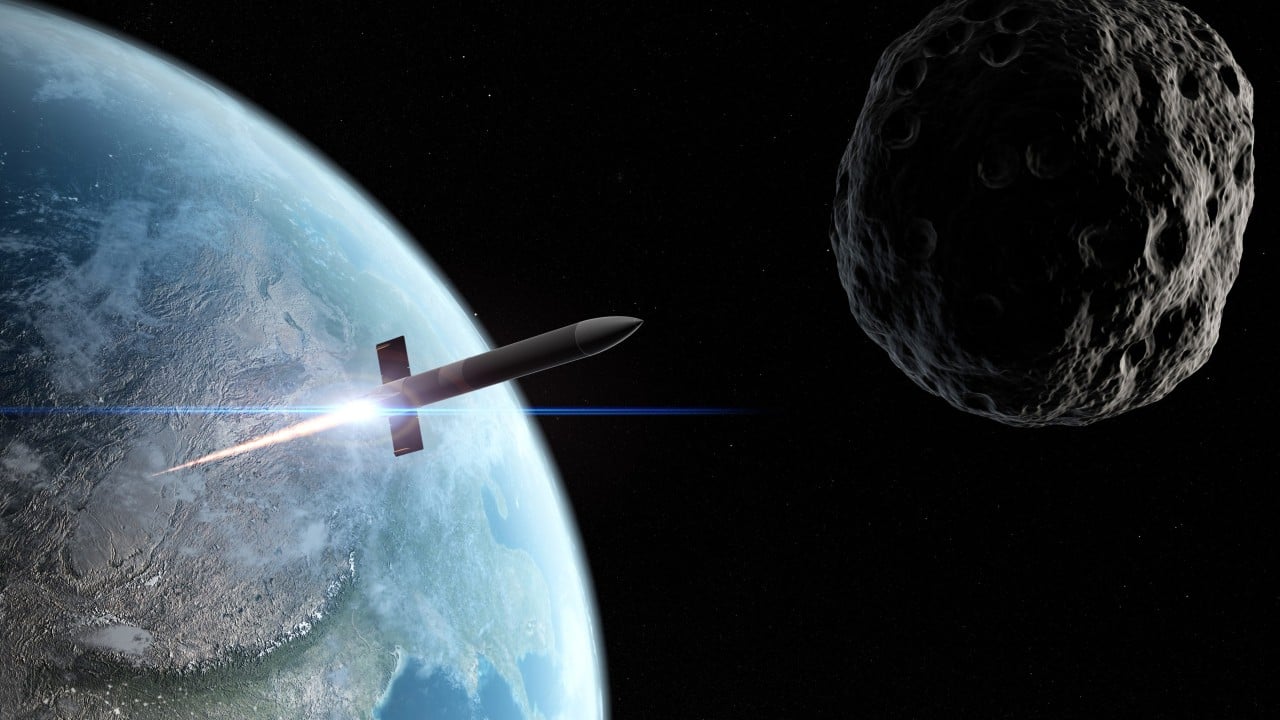
Chinese rocket scientists may have identified the most efficient method to neutralize or divert a colossal asteroid on a collision course with Earth – by inserting a nuclear bomb into its core and detonating it. According to a team from the China Academy of Launch Vehicle Technology in Beijing, the process involves first launching a metal probe to gouge a profound hole in the asteroid.
Subsequently, a second spacecraft would launch a nuclear warhead into the hole and detonate it, according to their study published in the Space: Science & Technology journal in May. Simulations conducted by the researchers suggest that a 3-megaton explosion, roughly equivalent to 200 Hiroshima bombs, could obliterate an asteroid measuring 100 meters in diameter.
They also discovered that positioning the bomb 30 meters beneath the asteroid's surface could amplify the asteroid's speed alteration by over three times compared to a shallower explosion. This strategy, reminiscent of the 1998 Hollywood film Armageddon, but carried out entirely by unmanned spacecraft, is considered more technically straightforward and effective in terms of defense compared to a direct bomb impact.
Rather than relying on a high-speed collision at a random point, this two-step method enables engineers to choose the precise location and depth for bomb placement. It also eliminates the risk of the nuclear device surviving a crash at up to 20 kilometers per second or exploding moments after impact, while simultaneously transferring a significant portion of the blast's energy into the asteroid.
Asteroids are remnants from the creation of the solar system around 4.6 billion years ago. The majority reside harmlessly between Mars and Jupiter, but some cross Earth's orbit and have been meticulously monitored by astronomers. In 2019, an asteroid up to 130 meters in diameter passed within 72,000 kilometers of Earth, detected by astronomers only shortly before its closest approach.
The only actual test of asteroid deflection to date was NASA's Dart (Double Asteroid Redirection Test) mission in 2022, which deliberately crashed a spacecraft into an asteroid and successfully altered its speed by approximately 2.7 millimeters per second. Nonetheless, for larger asteroids or those detected with minimal warning, a high-velocity impact might not suffice to avert a catastrophe.
In such scenarios, a nuclear explosion could be the only viable option, according to the Chinese team. To validate their theories, the researchers generated a computer-generated array of hypothetical Earth-threatening asteroids, assuming an approach speed of 10 kilometers per second. They then evaluated how various defensive strategies would perform against asteroids of different sizes, trajectories, and warning times.
The simulations revealed that a 50-meter asteroid could be entirely destroyed by a 300-kiloton nuclear explosion, roughly equal to 20 Hiroshima bombs. Increasing the yield to 3 megatons was sufficient to obliterate a 100-meter asteroid. The depth of burial also proved to be a crucial factor. For a 1-kilometer asteroid, placing a 3-megaton bomb 30 meters beneath the surface resulted in a velocity change of around 30 centimeters per second – more than three times the speed change achieved by a 10-meter burial and approximately 110 times the speed change from NASA's Dart mission.
The scientists acknowledged that the concept would only be applicable if a dangerous asteroid was detected early enough to design, launch, and execute the two-spacecraft mission before impact. It would also necessitate heavy-lift launch vehicles capable of delivering a penetrator and a nuclear payload into deep space. The authors concluded that their study provides a vital theoretical foundation for mission planning and engineering design of defense against large-sized or short-warning-time near-Earth asteroids, and holds significant strategic importance in enhancing humanity's capability to respond to asteroid impact threats.
Written by urgent.news from South China Morning Post's reporting — not their text. Machine-written — may contain errors; check the original before relying on it.
This story
This is one outlet's version. Read the fullest account.