Spanish North Africa enclave: How did the Ceuta crisis come about?
The events in Ceuta raise many questions: Did Moroccan security forces tolerate the assault? What motives could there have been? And who profited from the chaotic scenes?
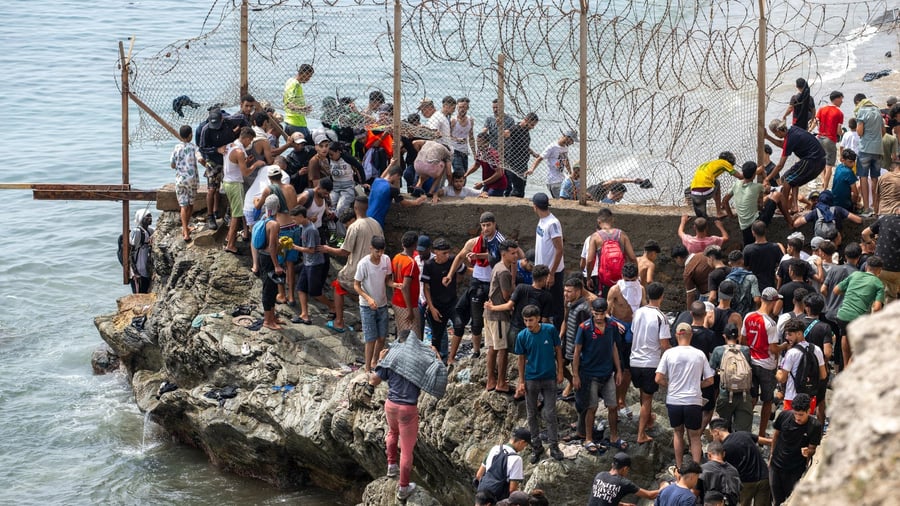
In the early hours, tens of thousands of people surged into Spain's North African enclave of Ceuta, residents barricading themselves in their homes while others threatened and attacked the often very young newcomers. These migrants initially wandered aimlessly and half-naked through the streets before returning to Morocco shortly afterward.
The situation in the enclave has since calmed considerably, but the chaotic images are likely to dominate the political debate about migration in Europe for some time. Nobody can pinpoint exactly how this happened, but many theories abound. Almost everyone in Spain agrees that the unprecedented surge would have been almost impossible without the at least temporary acquiescence of the Moroccan authorities.
The normally heavily guarded border is considered so sensitive and controllable that the tens of thousands of people would hardly have been able to cross it without the "approval or participation" of those responsible in Rabat, according to the Spanish newspaper "El País". The inaction of Moroccan security forces, documented in numerous videos, leaves no doubt.
The trail leads to Rabat, where some observers suggest that such an incident could only have been possible with the tolerance of the authorities there. King Mohammed VI rules the country with an iron fist, having massively expanded the security apparatus and digital surveillance with surveillance cameras. Many migrants, as reported independently by Spanish media, were neither stopped nor discouraged from attempting the border crossing.
However, the reasons behind the Moroccan interest in the chaotic scenes remain unclear. It is clear that Spanish Prime Minister Pedro Sánchez has become the cause of irritation in Rabat, despite close economic ties between the two countries. Sánchez had strengthened relations with Algeria - Morocco's neighbor and biggest regional enemy - during a visit last week.
In addition to the rivalry between the two African neighbors over the former Spanish colony of Western Sahara, Morocco also considers the two Spanish enclaves as "occupied Moroccan cities". Suspicion may also have arisen from the recent approval of a parliamentary committee in Spain on a bill designed to make it easier for Sahrawis - the indigenous people of Western Sahara - and their descendants to obtain Spanish citizenship.
In Spanish media, it is speculated that Morocco sees this as a provocation, as members of the Polisario-backed independence movement could be more easily pursued or prosecuted with an EU passport. The Polisario movement consists largely of Sahrawis. It is possible that Rabat wanted to send a signal to Madrid by relaxing border controls, although there is no evidence.
The suspicion, however, is not unfounded: In 2021, Spain accused Morocco of using migration and people as a means of pressure in the dispute over Western Sahara, when Madrid had taken the leader of the Polisario-supported movement Polisario to a hospital. Shortly after, more than 8,000 people arrived in Ceuta. Madrid called it "blackmail", while Rabat replied, "Actions have consequences."
Another theory is that Morocco wanted to show that its role as a border policeman for Europe is not self-evident. Morocco receives substantial EU funding for measures to curb migration. Another possibility discussed in this crisis is that Morocco wanted to demonstrate that its role as a border policeman for Europe is not self-evident.
The issue of the EU's financing of Morocco's border policing is also being debated. The gaze turns to Washington and Jerusalem, with speculation about possible signals sent by Spain's migration policy. These include the legalization of already living irregular migrants in the country and a court ruling that hinders refusals after sea entry.
While the first measure does not apply to newcomers, it is said that it may have given migrants false hopes. Other speculations go even further. Spain has strongly criticized both Israel's actions in the Gaza Strip and the US attacks on Iran, and has also resisted pressure from President Donald Trump to increase defense spending.
Some observers therefore speculate that Morocco may have acted in the interests of its close allies, the USA and Israel, to destabilize Spain's left-wing government and simultaneously spark migration and other debates in Europe. However, there is no credible evidence of involvement by the USA or Israel in the events in Ceuta. The Moroccan government also remained silent on the incidents on Saturday, with a government party close to the royal court only calling for a "national dialogue" on youth issues.
Some blame the government for neglecting the youth. Abdelhamid Bajouki, a journalist, writes that for those affected, "the sea is less terrifying than home." Young people with no prospects in Morocco are facing high unemployment, especially among young people. According to a study by the International Labour Organization (ILO), one in three people aged 15 to 29 has no job, no education, and no training.
Women are especially hard hit. Urban centers like Casablanca, Rabat, and Fez, as well as rural areas, offer few prospects for people, who often dream of a life in Europe. Many are lured by Spain and France, due to their geographical proximity and historical ties. The bordering countries host large Moroccan communities. Smugglers take advantage of the situation. While the government has tried for years to curb human trafficking, criminal networks persist.
Written by urgent.news from Handelsblatt's reporting — not their text. Machine-written — may contain errors; check the original before relying on it.