Wine tourism in Saxony: Bubbly or cudgel: Through the vineyards of the Elbland
The Saxon Wine Hiking Trail connects the businesses of the second smallest German wine region, which is celebrating a renaissance after difficult years during the GDR era. The sparkling wine is really taking off.
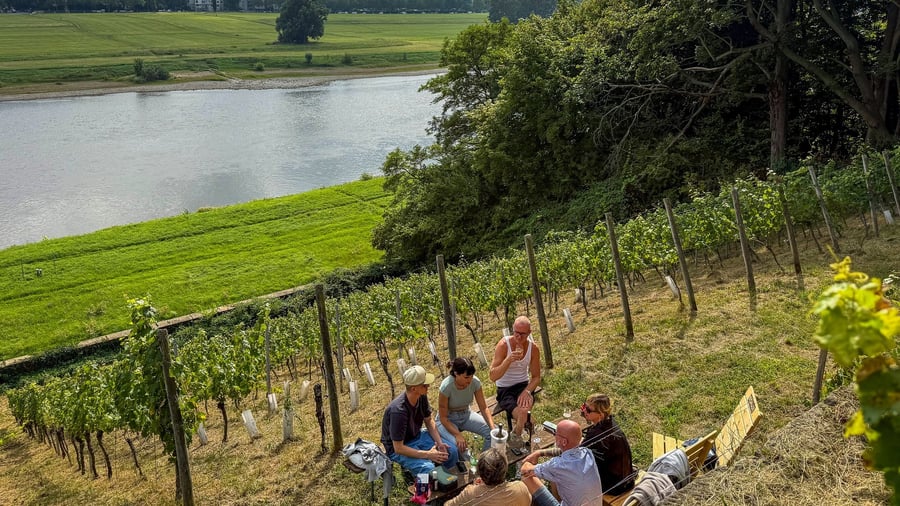
A lady opens the door at "The Three Gentlemen," leading tourists to the estate garden where old trees and sculptures draw attention before the gaze falls on the steep vineyards. As the sun has already set its zenith, Tanja Beck-Leyh offers wine to the walkers. She explains that the sparkling wine, made from pure Scheurebe, has a two-year bottle age and fine cassis flavors with moderate alcohol content.
This is an appropriate introduction to a tour of the Saxon Wine Trail, with Radebeul as its geographical center. This town was once the noble residence of Dresden and a favorite home of Karl May, whose eccentric villa stands open to visitors in the town center. Now, the winemakers have become serious competitors to May. They cultivate rare bottles from their niche, as their vines thrive between the Elbe's eastern shore and the surrounding hill chains on terraced vineyards that all face southwest for maximum sun exposure.
The pleasant surroundings also benefit visitors who choose Radebeul as the starting point for exploring the wine trail. Along the way, the marketplaces host smaller wineries for tasting their products, which are otherwise hard to find outside the region. One of these is the organic winery, Hoflößnitz, which also houses the Saxon Vine Museum.
Winemaker Jens Scherf explains why Saxon wine is rare elsewhere: "The production area is only 522 hectares, and we Saxons prefer to drink our own wine." As Scherf, the guest guide, points out, viticulture in the Elbe land has a long history marked by highs and lows. After its beginnings in 1161, it experienced its peak with over 5,000 hectares in the 17th century.
During the DDR era, it became a minor niche before a remarkable revival by small and medium-sized winemakers in recent years. In particular, sparkling wine is currently taking off. Unique Experience Winery All wineries in the Elbe land, however, stand out with Schloss Wackerbarth, which features a whimsical castle garden, a modern cellar, and a luxurious restaurant reminiscent more of an experience center like one might find in California.
Business Manager Jürgen Aumüller says the estate is unique in Germany: "At our place, every day is a day with open doors." However, the many events and 220,000 visitors per year are not the only special features. Instead, the house has dedicated itself to preserving the cultural landscape: "In our vineyards, there has been no land consolidation.
The typical dry stone walls are still as they were 400 years ago." Another extravagance is the Sachsenkeule, a keg-shaped bottle that, while impractical for storage, is so popular as a unique selling point that Wackerbarth even ships sparkling wines like Pinot Brut in it. The next stop is the Matyas family estate in the neighboring town of Coswig.
The estate announces its fondness for garden art from afar, as the vines enjoy the company of rose bushes and lush oleander. With eight hectares of vineyards, the estate is of manageable size, and according to Weber, this size will not change much as the available land is nearly exhausted. Thus, they focus on a qualitative upswing.
As the winemaker, a trained oenologist, explains, viticulture was not attractive during the DDR era because almost all grapes were supplied to Wackerbarth. Egoism or inventiveness prevented the folk winery from standing out back then. Prices like champagne are different for him: "I believe that we can produce the best sparkling wine in the world in Saxony."
Since acquiring a small vineyard at the Kapitelberg near Meißen, he is personally striving to achieve this goal: For his "Grand Terroir Meißner Kapitelberg Blanc de Noirs extra brut," Weber has already received several awards from specialist publications. The sparkling wine can already compete with champagne in price. A remarkable development that becomes less surprising knowing that Meißen is known as the birthplace of Saxon wine.
Although the city is famous for its porcelain, the joy of good wine lives on. The market square features a wine pavilion where young and old enjoy a glass of local wine on the benches around it. Alternatives are abundant. In Dresden, the nostalgic steam train "Leipzig" passes by the imposing Elbe castles and stops at a vineyard where Schoppen wines from the region make pleasant companions.
Along the way, one can also admire the Dresden Vineyard, managed by winemaker Lutz Müller. Perched high above the river, this garden restaurant creates an atmosphere reminiscent of a French film on warm summer evenings. Returning to Radebeul, the "Atelier Sanssouci" maintains this illusion. The Michelin-starred restaurant combines classic French elements with contemporary German touches.
Depending on the season and weather, either the garden hall of the historic "Villa Sorgenfrei" or its garden-like terrace provides an appropriate setting. It goes without saying that all the liquid companions primarily come from the Elbe land.
Written by urgent.news from Handelsblatt's reporting — not their text. Machine-written — may contain errors; check the original before relying on it.