Astronomers Have Detected an Exomoon for the First Time
A discovery in a solar system 73 light-years from Earth is challenging definitions and “blurring the lines between stars, planets, and moons.”
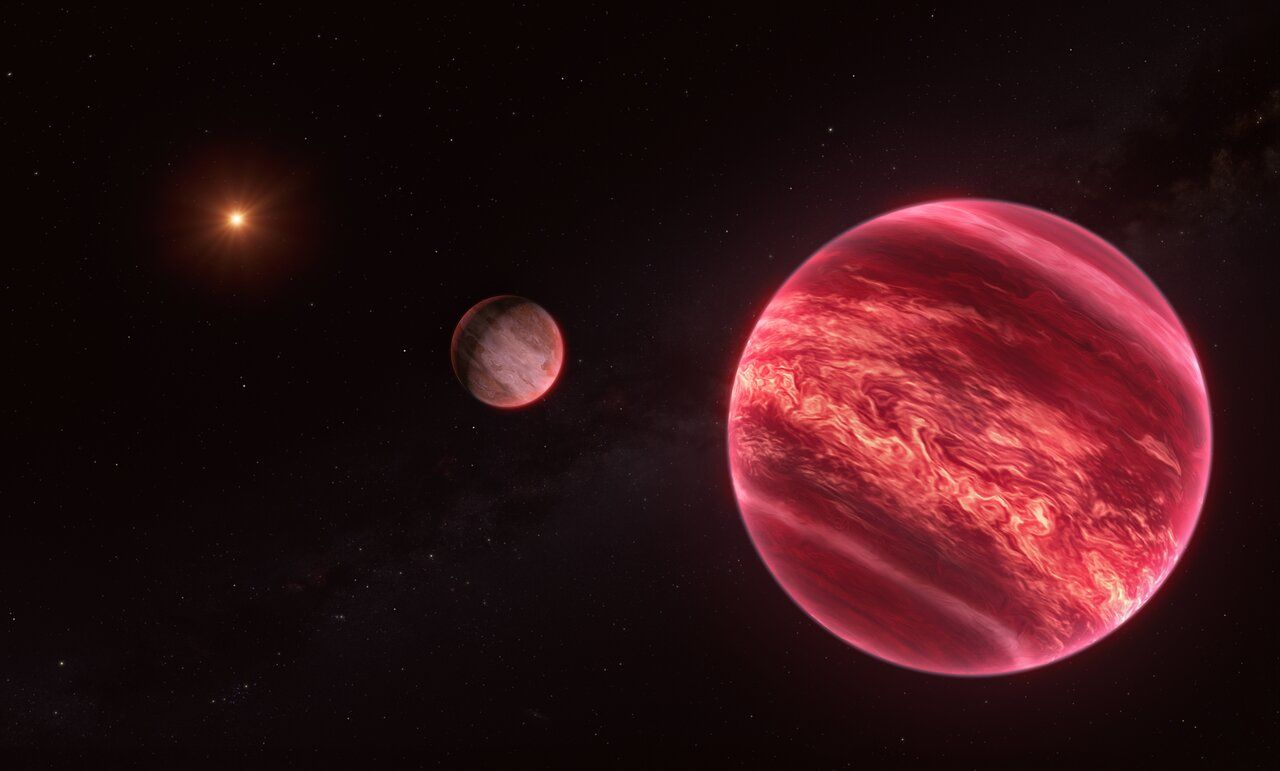
After decades of discovering over 6,000 exoplanets, astronomers have made a groundbreaking discovery: the first confirmed exomoon. This moon orbits a brown dwarf named CD-35 2722 B, located 73 light-years away. Brown dwarfs are celestial bodies that are larger than planets but smaller than stars, lacking the mass needed to ignite nuclear fusion and become a star.
CD-35 2722 B weighs about 37 times more than Jupiter and orbits a star roughly 40% the mass of our Sun. The team observed CD-35 2722 B for 23 nights between October 2023 and February 2026 using the CRIRES+ infrared spectrograph on the European Southern Observatory's Very Large Telescope. By employing the Doppler method, which measures changes in a celestial body's spectrum due to gravitational pull from a nearby object, the researchers discovered a strong signal indicating a large moon orbiting the brown dwarf.
This moon takes approximately 170 days to complete one orbit and has a mass at least 0.9 times that of Jupiter, making it considerably heavier than any moon in our solar system. The researchers ruled out other potential explanations for the observed signal, such as errors in Earth's orbital motion corrections, atmospheric variations, and the brown dwarf's rotation.
They also confirmed that the moon's orbit falls within a stable range, neither too close nor too far from the brown dwarf. While the term "exomoon" is not officially recognized, the researchers refer to it as an "exosatellite." This discovery challenges our understanding of moons in our solar system and opens up new possibilities for life and planet formation theories.
If smaller, rocky moons similar to the one found are discovered, they might generate heat through tidal forces, potentially creating life-supporting environments at greater distances from their stars. Future advancements in telescope technology may enable astronomers to detect even smaller exomoons, further enriching our understanding of the universe.
Written by urgent.news from Wired Science's reporting — not their text. Machine-written — may contain errors; check the original before relying on it.
This story
This is one outlet's version. Read the fullest account.