Op-Ed: Giving credit where it’s due — The US finally gets rare earth strategy
Washington's latest rare earth investment signals a strategic shift toward processing economics over resource size.
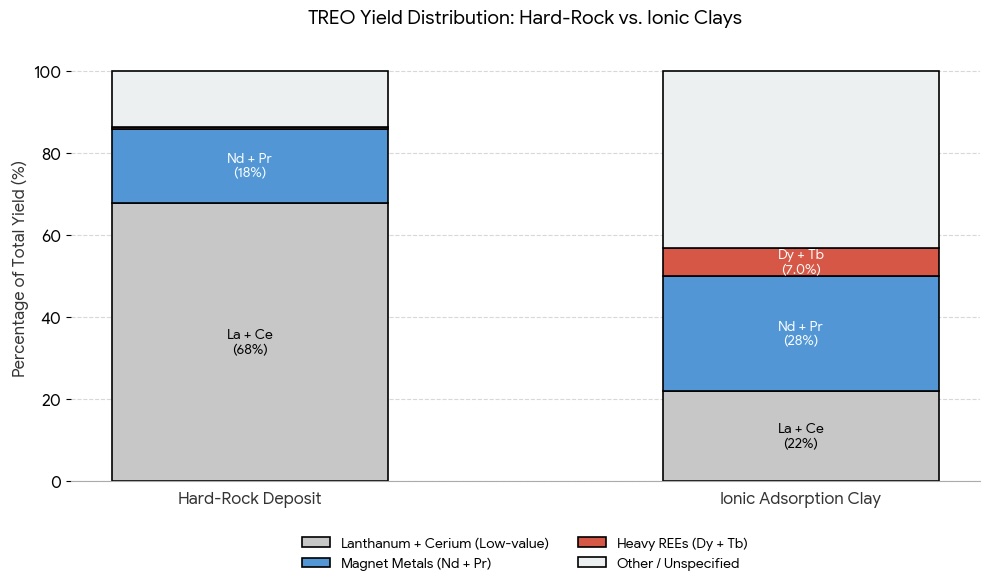
For years, Western nations have focused on treating rare earth elements (REEs) as a mining issue, overlooking their true nature as a chemistry problem. China's dominance over REEs has dominated headlines, prompting responses centered around building more mines. However, this approach overlooks fundamental metallurgical realities that dictate a project's commercial viability.
Most REE deposits are not equal in terms of economic and strategic value; they are dominated by two magnet metals—Neodymium (Nd) and Praseodymium (Pr)—which are crucial for electric vehicles, wind turbines, and defense systems. Hard-rock rare earth deposits primarily contain Lanthanum (La) and Cerium (Ce), accounting for 60% to 70% of the ore. These lower-value elements often require considerable energy and finances to process and separate, even before reaching the valuable magnet metals.
The geological ratio trap refers to the situation where producing more Nd and Pr results in larger volumes of La and Ce, increasing costs without necessarily generating proportional revenue. This challenge escalates with market demand dynamics, offtake constraints, and geopolitical factors. Consequently, the distinction between a large rare earth resource and a strategically valuable one is far greater than commonly perceived.
The ionic adsorption clay deposits hold particular strategic value as they require less energy-intensive crushing and roasting compared to conventional methods. These deposits, naturally rich in Nd, Pr, Dysprosium (Dy), and Terbium (Tb), are predominantly found in China. However, the Phalaborwa project in South Africa challenges this concentration due to its unique characteristics.
Phalaborwa is a 35-million-tonne deposit of phosphogypsum generated from decades of fertilizer production. Despite initial appearances, it contains recoverable rare earths due to previous mining operations. Rainbow Rare Earths has further enhanced the project's economics through a proprietary cerium-depletion process that removes 65% of low-value Cerium before final rare earth production.
Additionally, the feedstock contains negligible amounts of Thorium and Uranium, mitigating another common challenge for rare earth developers.
Operating costs for Phalaborwa are projected to be below $30 per kilogram of Nd and Pr, making it an economically attractive option. The US's $50 million equity commitment to this South African project, despite diplomatic tensions with Pretoria, sends a strong message about securing access to competitive magnet metals independent of China.
This represents a significant shift in thinking from simply backing large resources based on total rare earth tonnage to investing in projects with favorable metallurgy and lower processing costs.
Phalaborwa challenges the assumption that Western policy primarily focuses on finding the next major deposit. Instead, policymakers may be asking a more crucial question: which project offers the best combination of favorable geological endowment and economically viable processing methods? This shift in priorities highlights a growing recognition that supply-chain resilience is increasingly about establishing reliable international partnerships rather than insisting on every link being within national boundaries.
Written by urgent.news from Mining.com's reporting — not their text. Machine-written — may contain errors; check the original before relying on it.