Ask Ethan: What would “first life” see in their night sky?
We see our Universe as it is today: 13.8 billion years after the Big Bang. Because of how quickly and how long it’s been expanding and cooling, the Universe is now sparse, possessing less than 1 proton per cubic meter of normal matter on average. Dark matter and dark energy, not normal matter, dominate our Universe’s contents today, and the expansion rate is much lower, around 70 km/s/Mpc, than…
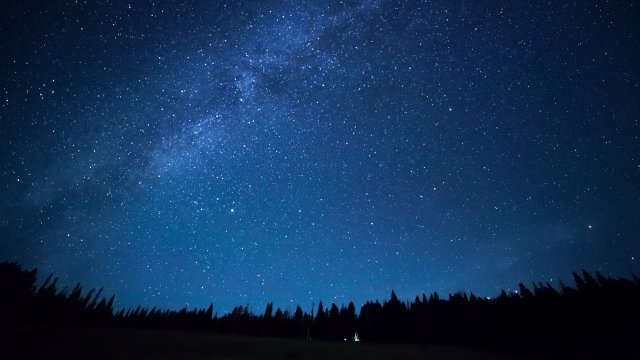
Imagine, if you will, a sentient being emerging on a distant world, perhaps only a mere billion years after the cataclysmic birth of the cosmos itself. This creature, bearing witness to the fledgling Universe, would view its night sky vastly different from the cosmic panorama we know today. In the earliest epochs, there were no stars to illuminate the darkness, no planets to orbit, and not even the faintest trace of heavy elements that would eventually give rise to life as we know it.
The young Universe was a barren expanse, devoid of the complex molecules and rocky worlds that are the precursors to life. It is only through the relentless cycle of star formation and stellar death, where elements forged in stellar furnaces are spewed into the interstellar medium, that the ingredients for life can eventually coalesce. As the Universe ages, the interstellar medium becomes increasingly enriched with heavy elements, paving the way for the formation of planets and the emergence of life.
For the hypothetical first form of intelligent life to arise, it would have to witness the slow but inevitable transformation of the cosmos. The night sky would initially be a void, punctuated by the occasional flicker of a nascent star. As time passes, more stars would ignite, merge, and ultimately explode, scattering the raw materials necessary for life across the Universe.
Over eons, these stellar remnants would accumulate into the heavy elements required for the construction of planets and the emergence of complex organic compounds.
It would be a long and arduous journey, one fraught with challenges and uncertainties. The first form of life would have to endure the harsh conditions of a Universe still in its infancy, a time when stars were scarce and the interstellar medium lacked the heavy elements necessary for life. Yet, as the Universe ages and evolves, the stage would be set for the emergence of intelligent life, capable of contemplating the cosmos and pondering its own origins.
In this hypothetical scenario, the earliest form of intelligent life would have a unique perspective on the Universe, one shaped by the slow and painstaking process of cosmic evolution. Their night sky would be a testament to the enduring power of the Universe to give rise to life, a reminder of the slow and steady march of time that ultimately leads to the emergence of sentient beings capable of contemplating their own existence.
Written by urgent.news from Big Think's reporting — not their text. Machine-written — may contain errors; check the original before relying on it.