‘Photonic multi-lane highway’ enjoys insulator-free topological protection
New technology uses a photonic valley half-semimetal The post ‘Photonic multi-lane highway’ enjoys insulator-free topological protection appeared first on Physics World .
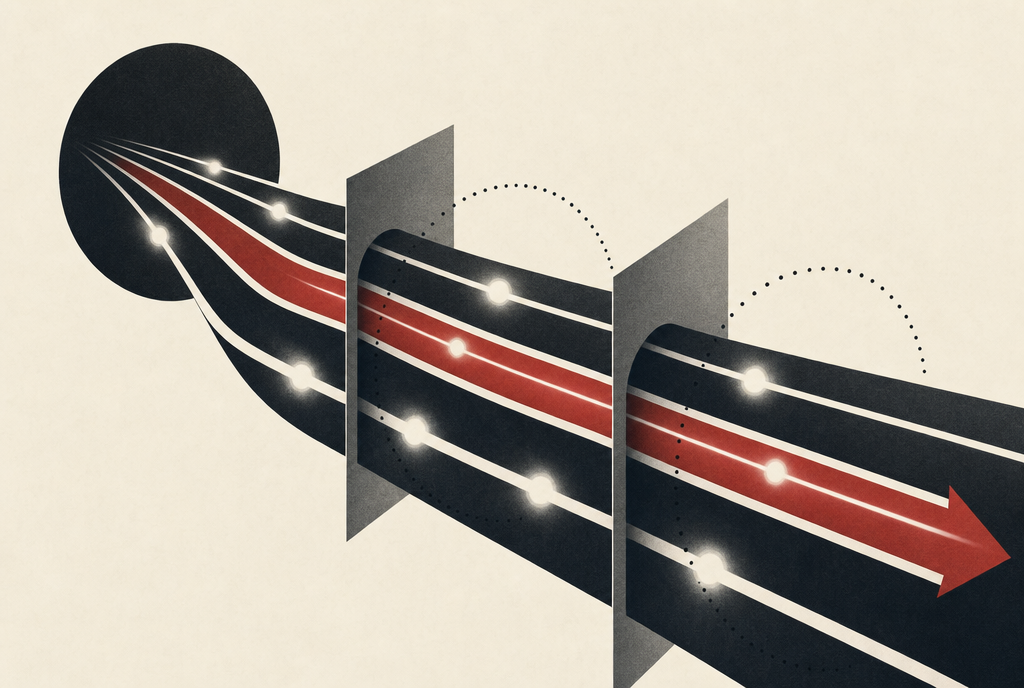
In a breakthrough for photonic technology, researchers in China have demonstrated a "photonic multi-lane highway" that can transport multiple topologically-protected optical signals simultaneously without the need for bulky insulators. This innovative technology relies on a novel material known as a photonic valley half-semimetal, which allows for superior spatial efficiency and topological robustness.
Despite current prototype status, researchers are optimistic about the potential for future applications in photonic technologies. Traditional photonic topological insulators have been widely used in on-chip photonic circuits due to their ability to guide light unidirectionally with minimal scattering. However, these insulators require an optical band gap, making them opaque to the relevant frequency.
The new photonic valley half-semimetal addresses this trade-off by utilizing the valley degree of freedom, which allows for independent transport channels. Four stacked layers of a honeycomb structure made from interconnected rods of magnetic material were used to create four photonic valley half-semimetal domains arranged in a specific sequence.
This design effectively creates a four-lane highway, with two lanes in each direction, allowing signals to navigate sharp bends and constrictions without backscattering or inter-lane crosstalk. While the current device operates at microwave frequencies, the researchers believe the design can be adapted for higher frequencies, paving the way for compact topological photonic circuitry.
Potential applications in the terahertz regime are also considered feasible using magnetized semiconductors such as indium antimonide. Despite the promise of this technology, challenges remain in realizing higher-frequency designs and managing fabrication complexities. Nonetheless, the researchers believe their work highlights a significant issue in topological physics and brings attention to the importance of spatial efficiency in the field.
Written by urgent.news from Physics World's reporting — not their text. Machine-written — may contain errors; check the original before relying on it.