Active dendrites enable robust spiking computations despite timing jitter
Dendritic action potentials exhibit long plateaus of many tens of milliseconds, outliving axonal spikes by an order of magnitude. The computational role of these slow events seems at odds with the need to rapidly integrate and relay information throughout large nervous systems. We propose that the timescale of dendritic potentials allows for reliable integration of asynchronous inputs. We develop…
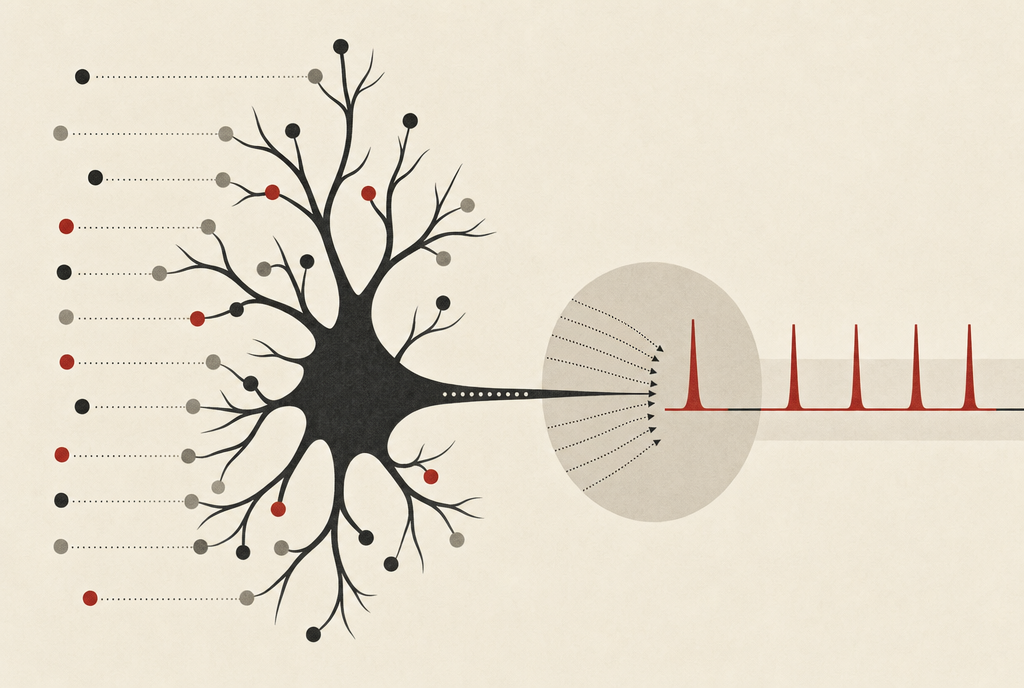
Dendritic action potentials hold a significant computational role in the nervous system, despite their prolonged duration, which is considerably longer than that of axonal spikes. These slow events, lasting tens of milliseconds, have long baffled scientists due to their apparent mismatch with the rapid information relay requirements of large neural systems.
The key to understanding their function lies in their ability to provide each dendrite with a resettable memory of incoming signals. This characteristic has been incorporated into a physiologically grounded model, which effectively captures the nonlinearities observed in dendritic behavior both experimentally and in more intricate, detailed models.
The behavior of these extended dendritic spikes proves to be an effective solution for neurons to reliably spike even when confronted with asynchronous input spikes. This capability is crucial for computing non-trivial tasks within a network that employs sparse spiking under conditions of timing jitter. The model demonstrates that the specific timecourse of dendritic potentials plays a pivotal role in ensuring decisions are made quickly, reliably, and with minimal spiking activity.
This finding offers empirically testable hypotheses regarding the role of dendritic action potentials in cortical function, as well as a potential bio-inspired approach to realizing neuromorphic spiking computations using analog hardware.
Written by urgent.news from eLife's reporting — not their text. Machine-written — may contain errors; check the original before relying on it.