Diffuse puffs of “missing” matter surround most galaxies
An MIT-led team used bright radio bursts to illuminate a vast source of matter that was previously unaccounted for.
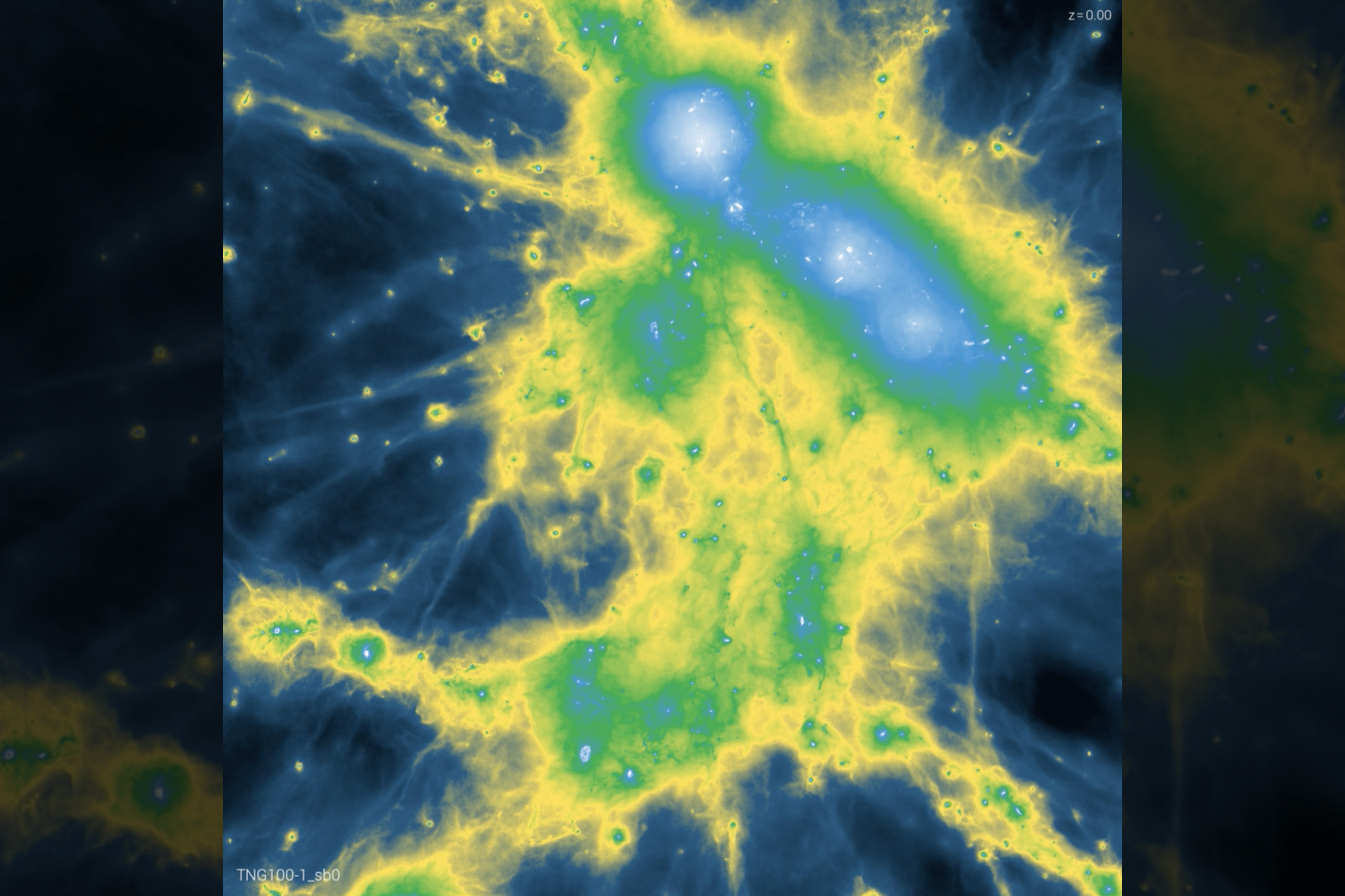
Scientists have discovered diffuse clouds of "missing" matter surrounding most galaxies, using fast radio bursts (FRBs) as a tool to probe the universe. For decades, researchers have struggled to explain the discrepancy between the estimated amount of ordinary matter in the early universe and the amount of visible matter found in stars and galaxies today. Now, a team led by MIT has developed a method to search for missing matter by analyzing the smearing of FRB signals as they pass through space.
Fast radio bursts are incredibly brief, ultrabright flashes of radio waves emitted by extremely energetic phenomena in the distant universe. As the signal from a FRB travels through space, it gets stretched and "smeared" in time. The more missing matter that the signal passes through, the more smeared it becomes. The MIT-led researchers measured the degree of smearing experienced by thousands of FRB signals detected on Earth and compared each smearing pattern with locations of galaxies across the universe.
Their findings revealed that missing matter exists in very diffuse clouds surrounding groups of galaxies, extending further out than previously thought. Haochen Wang, a graduate student involved in the study, explained that the amount of missing matter correlates with the number of galaxies present in a region. The researchers also discovered that the processes responsible for ejecting this missing matter—such as black hole jets, exploding stars, and other highly energetic events within galaxies—are likely stronger and more violent than previously estimated.
The study, published in the journal Physical Review Letters, supports the idea that missing matter is flung outside galaxies through various energetic processes. This new method using FRBs provides a unique way to map the shape of missing matter around galaxies, offering insights into how galaxies form and interact with their environment.
Written by urgent.news from MIT News Research's reporting — not their text. Machine-written — may contain errors; check the original before relying on it.