ESA’s Mars Express meets NASA’s Psyche
Image: Mars Express image
On 15 May, NASA's Psyche mission executed a gravity assist flyby of Mars, passing just 4500 km above the Martian surface. The spacecraft utilized the Red Planet's gravity to alter its trajectory and velocity, a common maneuver for interplanetary missions. However, the flyby also offered an opportunity to test Psyche's science instruments, including its camera.
In response to the flyby, the teams behind ESA's Mars Express and its High Resolution Stereo Camera (HRSC) pondered whether the two spacecraft's paths would intersect, allowing them to capture the same area of Mars at nearly the same time. To facilitate this, the teams coordinated their observation plans weeks in advance, exchanging trajectories and observation schedules.
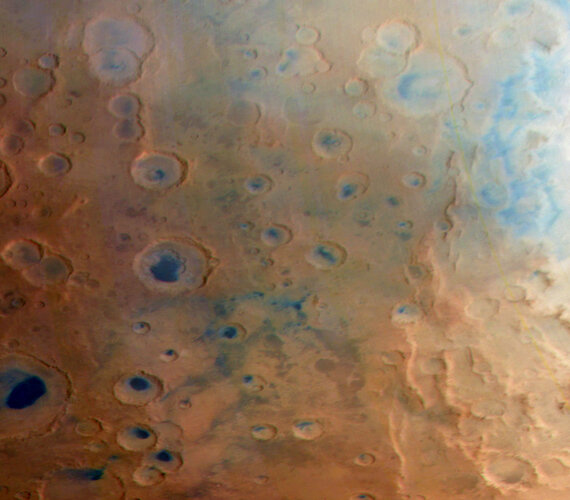
The resulting images reveal one of two coordinated observations. The left image is captured by Mars Express, while the right image is taken by Psyche's camera, with the latter taken 1 hour and 50 minutes after the closest approach. The scene depicted is part of Noachis Terra, one of the oldest regions on Mars's surface, marked by numerous craters filled with sand dunes displayed in dark blue.
Despite being captured in close succession, the two images were taken from vastly different distances and angles. At the time Psyche passed over the region, about 2.5 hours after its closest approach, its altitude had risen to approximately 41,000 km. In contrast, Mars Express was at a mere 6,000 km altitude and observed the scene from an inclined angle. Consequently, the images exhibit varying resolutions and viewing perspectives.
These coordinated observations serve a dual purpose: they offer visual comparisons and potentially contribute to calibrating Psyche's camera. By comparing the brightness and color values in each pixel, scientists can detect subtle differences in how the two cameras respond to light. While further investigation is required to determine the feasibility of using these observations for calibration, they hold the potential to enhance the performance of Psyche's camera, ensuring optimal functionality during its future missions.
Written by urgent.news from ESA Space Science's reporting — not their text. Machine-written — may contain errors; check the original before relying on it.