When peace given no chance
To say that 'Campo Minado' – the powerful Malvinas war play brought back to life by the Buenos Aires Herald, DG Experience and the British Council – is a call for peace is both to convey its central message and to fall short. The question it poses is not so much who can argue with peace as who should argue for it? Leer más
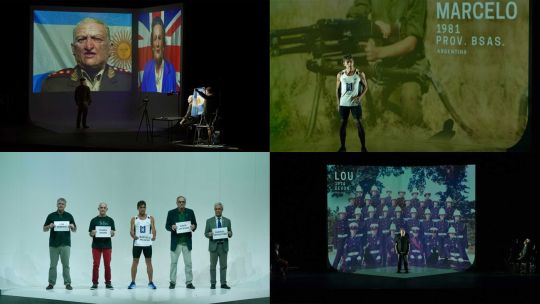
In 1982, Britain and Argentina clashed over the Falkland Islands, known as the Malvinas to the Argentine side. As a British immigrant to Argentina in the 1980s, the columnist worked for the Buenos Aires Herald for 34 years and saw the war as a central topic. To mark the paper's 150th anniversary, the Herald staged a play called Campo Minado at the Teatro Coliseo. This review is published on the 36th anniversary of Margaret Thatcher's final day as Prime Minister.
Living in Hamburg at the time, the columnist couldn't claim to be an eyewitness to the war, as they were working in Germany during those 74 days. Yet, they followed the conflict closely through BFBS, a British radio station for troops in northwestern Germany. While not an impartial source, it was the only way to stay updated on the war.
The reviewer found that only about 10% of the audience at the Teatro Coliseo could say the same, highlighting the importance of this play. Campo Minado is more than just a call for peace – it poses the question of who should argue for it. The play features veterans who have experienced war firsthand and are now advocating for peace.
Donald Trump's Board of Peace is criticized for being indifferent to peace, while beauty contestants often list world peace as their top wish. The play emphasizes that peace is an abstraction without fully understanding the horrors of war. At the end of the play, veterans challenge the audience about their experiences during the war.
The cast includes Lou Armour, who played a key role in launching the play 10 years ago as one of the 68 Royal Marines who surrendered to Argentine forces in Stanley. He was there for the Argentine surrender six weeks later. Tip Cullen replaced Armour, losing authenticity but gaining dramatic force.
Other cast members include David Jackson, a British member of the original cast who spent the war decoding radio messages and now works as a psychologist providing free therapy in the play. Gurkha Sukrim Rai couldn't participate due to a domestic accident but serves in the play to highlight the truth as a casualty of war, exposing latent racism in Argentina.
Argentine perspectives are also presented, such as sailor Rubén Otero, one of the 770 survivors of the ARA General Belgrano torpedoed on May 2. He spent over 40 hours on a raft before being rescued and is now passionate about drumming to Beatle music. Gabriel Sagastume, a reluctant soldier and lawyer, bears witness to the fact that the war dead are not always the fault of the other side.
He is the only survivor of a starving platoon that raided an empty cottage for food, only to step on a landmine while returning, blowing himself and his comrades up.
The play's title, Campo Minado, perfectly encapsulates the horrors of war experienced by these veterans. Marcelo Vallejo, one of the survivors, spent the occupation manning a mortar on Wireless Ridge and is now a champion athlete in his mid-sixties. While there is one criticism – the background music omits Rod Stewart's 'We Are Sailing,' the British war anthem – the play successfully chronicles the war from start to finish while incorporating the testimony of its participants.
Rewritten by urgent.news; may contain errors — check the original.
Source: batimes.com.ar