Snails cause harvest headache for South Australian farmers
An increase in snail numbers is causing issues for some farmers in the middle of what is expected to be a record-breaking harvest.
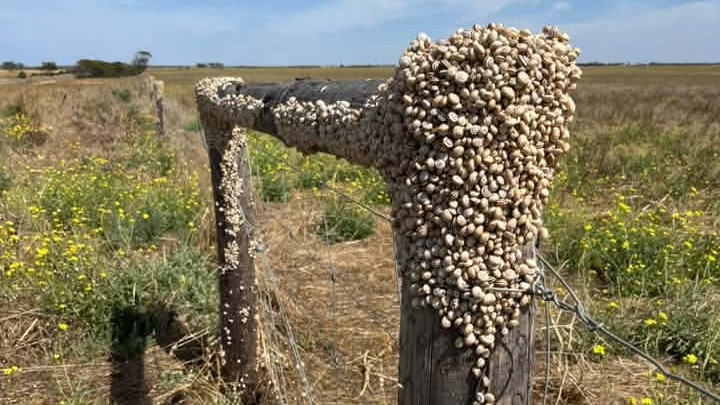
Grain farmers across parts of South Australia are facing significant challenges due to an unprecedented snail infestation. These pests are causing grain to be downgraded at silos, leading to decreased prices for farmers. Farmers are required to go through rigorous cleaning processes to reduce snail numbers before the grain can be sold.
On the Yorke Peninsula, fifth-generation farmer David Edwards has observed an extreme amount of snails in his crops, with hundreds present in nearly every paddock. These alkaline soils, prevalent on the Yorke Peninsula, provide the ideal environment for snails to thrive.
During the harvest process, snails pose numerous challenges. They are restricted to a limit of two per half litre at the silos, which becomes difficult to maintain when thousands of snails are present in the grain. This leads to additional costs and labor required to clean the grain properly. The snails also create mess in the header and augers while harvesting, adding to the financial burden.
At the silos, a high snail count can result in grain being downgraded, reducing the amount farmers receive for their produce. One of Edwards' canola loads was downgraded due to just three snails. Grain receiver T-Ports has reported a higher number of snails this year, particularly from coastal growers on the Eyre and Yorke peninsulas.
Upon reaching the silos, grain samples are tested, and the delivery is graded accordingly. For instance, wheat deliveries must contain only one snail per half-litre sample for grades H1 to ASW. If the snail limit is exceeded, the grain is downgraded to AGP quality. Prices for different grades vary; at the time of writing, APW1 wheat was priced at $330 per tonne in Wallaroo on the Yorke Peninsula, while AGP1 was priced at $295 per tonne.
With South Australia producing 6.8 million tonnes of wheat in 2022-2023, the price difference between APW1 and AGP1 could amount to over $50,000 per farm if all 4,500 grain farms in SA produced wheat. Some farmers are content with taking whatever price they can get due to the snail issue, while others may salvage the grain by taking it home to process it through a snail crusher. For David Edwards, the snails have been a considerable setback to an otherwise record-breaking harvest.
Rewritten by urgent.news; may contain errors — check the original.
Source: abc.net.au