New satellite data shows how fast some African cities are sinking
Cities including Lagos and Alexandria are sinking faster than previously thought, a new study shows.
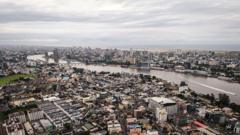
African metropolises are sinking at a faster rate than previously understood, according to a recent research project. Using radar imagery from Europe's Sentinel-1 satellites, scientists mapped the land movements beneath 20 coastal African cities. The study revealed that cities like Lagos and Alexandria are experiencing more rapid sinking than UN climate body estimates from 2021.
While some subsidence, or land sinking, is natural, much is caused by human activities, such as groundwater extraction. The lead author, Oluwaseyi Dasho, noted that the consequences of subsidence are often unnoticed in daily life, but can significantly increase flood risks over time, as sinking ground becomes lower relative to the ocean, exacerbating the effects of sea level rise due to climate change.
The research estimated that by 2050, seven million people, one billion buildings, and $180 billion in assets could be at risk of flooding. Historically, the lack of monitoring stations in Africa has hindered scientists' ability to obtain localized information on subsidence. However, satellite data enabled the researchers from Virginia Tech to detect land movements as small as 1mm per year.
Senior author Manoochehr Shirzaei explained that Sentinel-1 satellites pass over the same regions approximately every six to 12 days. The radar signal transmitted by the satellites, which hits the ground and bounces back, allows for the recording of the time between sending and receiving the signal. Changes in this value over time indicate how much the land has moved.
In the study, the ground under Alexandria and Lagos was found to have subsided an average of 6mm and 5mm per year, respectively. If this trend continues, sea levels around Alexandria could rise 36% more by 2050 than the IPCC predicted under middle emission scenario estimates. Luanda, in Angola, has also undergone significant subsidence, while other cities like Durban, in South Africa, have remained stable or even risen slightly.
The man-made factors contributing to subsidence are often localized, making it possible to combat the issue through local policies. One major cause is the excessive water consumption of rapidly growing cities, which can lead to soil compaction and surface sinking when too much water is extracted from the ground. The Aswan Dam on the Nile may also be trapping sediment upstream, preventing the replacement of sinking land in Alexandria, as suggested by the study.
In Lagos, the creation of artificial islands and construction on loose ground are other possible causes of subsidence. Preventing cities from sinking involves supplying alternative water sources and cultivating less water-intensive crops. "Whatever we cannot mitigate, we try to adapt to it," Shirzaei added, suggesting methods such as building flood defenses or relocating key infrastructure to higher levels.
The study's findings could be crucial in addressing the knowledge gap for developing countries, like those in Africa, due to a lack of monitoring. Shirzaei hopes that the research, published in Science Advances, can assist African governments in preparing for future challenges and the well-being of future generations.
Rewritten by urgent.news; may contain errors — check the original.
Source: bbc.co.uk