Merkur-Sonde: Nach Problem: Nächste Manöver von „BepiColombo“ stehen an
Zehn Milliarden Kilometer hat „BepiColombo“ zurückgelegt und ist endlich am Ziel angekommen: In der Merkursphäre. Doch nicht alles verlief nach Plan. Was heißt das für die Mission?
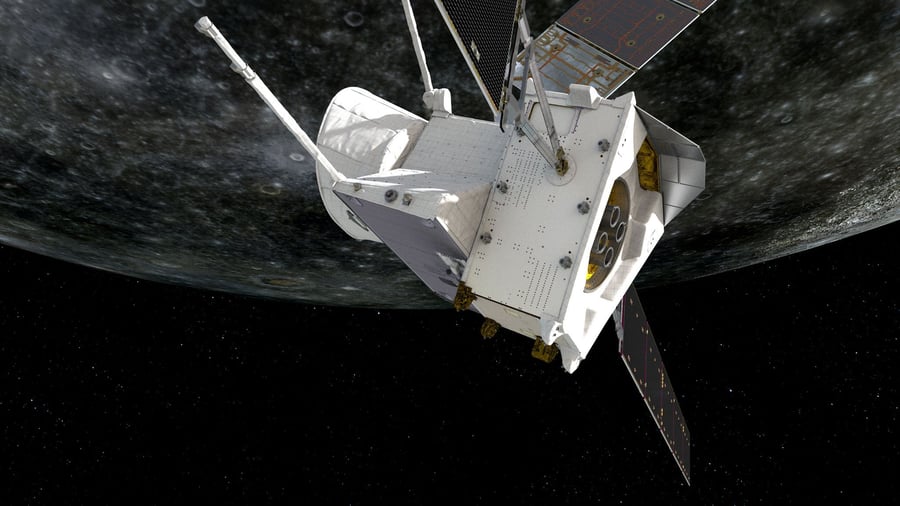
Following a software issue during the Mercury probe "BepiColombo" entering the sphere of its target planet, experts are planning the next maneuvers with a temporary solution. The ideal solution would be to perform a software update, but time constraints were mentioned by Frank Budnik, responsible for the flight dynamics of the probe at the European space agency Esa.
"The maneuver sequence is too tightly timed and the current mission phase is time-critical," he told Deutsche Presse-Agentur dpa. However, they have found a way to command the maneuvers differently. "We are convinced that this problem will not recur again." The mission aims to explore the next planet in the Solar System, helping to better understand its origins.
After an eight-year journey through the inner Solar System, the probe recently entered into orbit around Mercury. However, due to a software problem, the spacecraft entered at a slightly further orbit than originally planned - the thrust had been interrupted. In the coming days, the probe will be lowered into smaller orbits in four steps - these maneuvers will sometimes be larger due to the problem.
With the €1.7 billion joint mission, researchers want to learn more about the next planet. The two satellites of "BepiColombo" are to examine among other things the magnetic field and map the surface. Questions such as whether there is water on Mercury, what the planet is made of and how it was formed, are being addressed. The probe was launched in 2018, has traveled over ten billion kilometers and will be controlled from the Esa control center in Darmstadt.
Timing constraints due to an approaching eclipse limit the options. The two satellites of "BepiColombo" are to reach their respective orbits after a separation in December and March, scientific work will begin in April. "So far we are still on schedule," said Christoph Steiger, deputy flight director of "BepiColombo" to dpa. However, there is a critical aspect, as on December 20th begins a dark period.
"That means Mercury is temporarily between the satellite and the Sun, and the satellite has to survive on its own battery there." The higher the orbit, the longer the darkness, Steiger explained. And the battery has limited capacities. "So theoretically, if the orbit was not lowered sufficiently within about a month, the satellite could theoretically be lost.
But we are far from that." Steiger also added that in the timeline there are still various options if it really comes down to the wire.
Rewritten by urgent.news; may contain errors — check the original.
Source: handelsblatt.com