Hypersail: Von der Straße auf die Weltmeere: Diese Superjacht soll Ferraris Zukunft sichern
Nach dem elektrischen Ferrari Luce arbeitet der italienische Rennwagenbauer an seinem nächsten kontroversen Projekt: Dieses Mal wollen die Ingenieure die Weltmeere erobern. Ein Ortsbesuch.
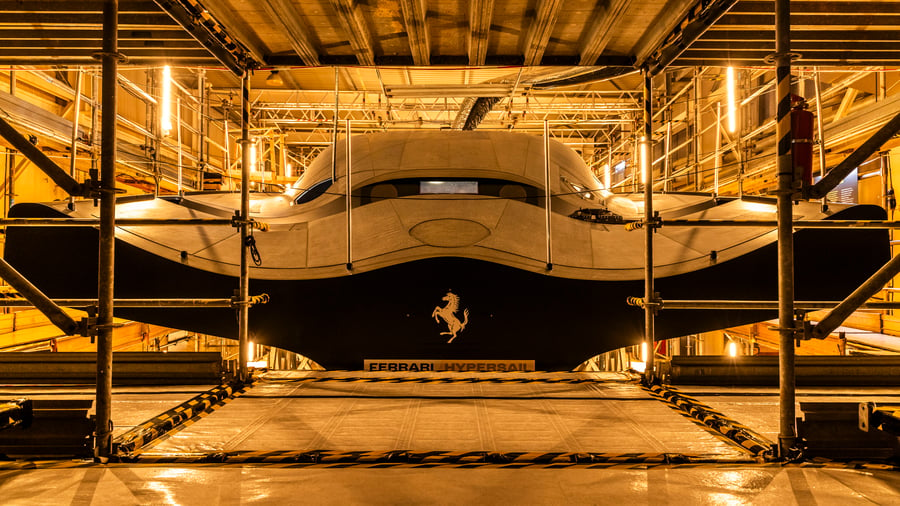
The object emerging from the construction site resembles a spaceship: a capsule, round at the top and pointed at the bottom, tapering into what appears to be a wing along its sides. Just as a spaceship is designed to fly, this capsule too is meant to soar – not through the heavens, but over the world's oceans. Adorning its bow is the Cavallino Rampante, Ferrari's signature emblem, which thus far has only adorned the marque's sports cars.
This is the latest project from the Italian racing car manufacturer. Located in the countryside near Pisa, roughly a two-and-a-half-hour drive from the company's headquarters in Maranello, engineers and builders are constructing a world-first: the high-sea yacht Hypersail, which aims to set records.
For around one-and-a-half years, a team has been working on the project: in April, they removed the form in which the ship's hull had been fabricated. Today, on a stormy November morning, they stand close to completing the ship. Project leader Enrico Voltolini, standing on the ship's hull and gazing at the closed cockpit, speaks with awe in his voice.
He climbed two floors up to reach the construction site and now peers through the cockpit. Two shipbuilding experts are wiring solar panels installed on the deck to the ship's onboard electronics. "A day like today with a strong southwest wind will be impressive and tricky to handle on the boat," he says. Voltolini knows what he's talking about.
The 40-year-old shipbuilding engineer is not only the Hypersail project leader but also a competitive sailor, having participated in some of the most demanding races worldwide, from the America's Cup to SailGP. A billion euros in research and development
Ferrari's investment in the Hypersail project underscores its ambition to maintain excellence in transportation, independent of internal combustion engines. Professor Lucio Lamberti, an expert in economic engineering at the Politecnico di Milano university, affirms that the Hypersail project confirms this aspiration. Not only will the yacht be completely energy-autonomous, but it will also require no additional investment, as the necessary funds have already been allocated.
As of November, Ferrari increased its profit forecast for 2026, anticipating at least three billion euros in net profit after accounting for taxes, interest, and depreciation. The company is currently valued at approximately 64 billion euros, and its commitment to selling all cars by early 2028 demonstrates its financial health and the success of its luxury positioning strategy.
Ferrari has already invested over one billion euros in research and development by 2025, and it is expected to continue investing in the Hypersail project, although the exact cost remains undisclosed. The investment aims to enhance the brand's prestige, showcasing Ferrari's ability to transfer its expertise from Formula 1 and sports cars to other fields.
With the foiling technology named in the yacht's name, Ferrari aims to demonstrate its mastery in transferring its knowledge from Formula 1 and sports cars to other domains. Flying thanks to foiling technology, the yacht is named after the Hypercars that Ferrari used to win the Le Mans race three years in a row between 2023 and 2025.
The finished yacht will be around 30 meters (100 feet) long and 44 meters high, roughly equivalent to the height of a village church tower and as long as the wingspan of a medium-range aircraft. Its rear axle and electric motor, once developed for the Luce, will be housed within the yacht. The motors will control the hydrofoils, or underwater lift surfaces, and the sail and wind system, which are managed by the Flight-Control System, a software developed by Ferrari engineers' expertise in electronics and dynamic vehicle regulation.
This system will free the eight to ten-person crew to focus on the essentials: the sky, the wind, and coordinates. Powered entirely by renewable sources, including solar panels and up to three wind turbines mounted at the stern, the yacht will navigate at two to three times the speed of the wind. Utilizing foiling technology, the yacht will glide above the water surface, significantly reducing water resistance and enabling it to reach speeds two to three times greater than the wind speed.
The America's Cup yachts already employ this technology but on a smaller scale, competing in short races close to the coast. The main challenge for the Hypersail is to implement this technology on an unusually large vessel over open waters without interruption, potentially for weeks. While other yachts, such as those in the Vendée Globe race, have navigated continuously for over 60 feet in size, the Hypersail will be significantly larger.
Its goal is to demonstrate its potential by setting a world record for the fastest solo circumnavigation in a sailing yacht. The Jules-Verne Trophy awaits the yacht that breaks the world record for the fastest solo circumnavigation.
Rewritten by urgent.news; may contain errors — check the original.
Source: handelsblatt.com