Banks Embrace AI but Lag on Governance
Banks are rushing to adopt AI in decision-making, but lagging governance and risk oversight create serious blind spots. The post Banks Embrace AI but Lag on Governance appeared first on Global Finance Magazine .
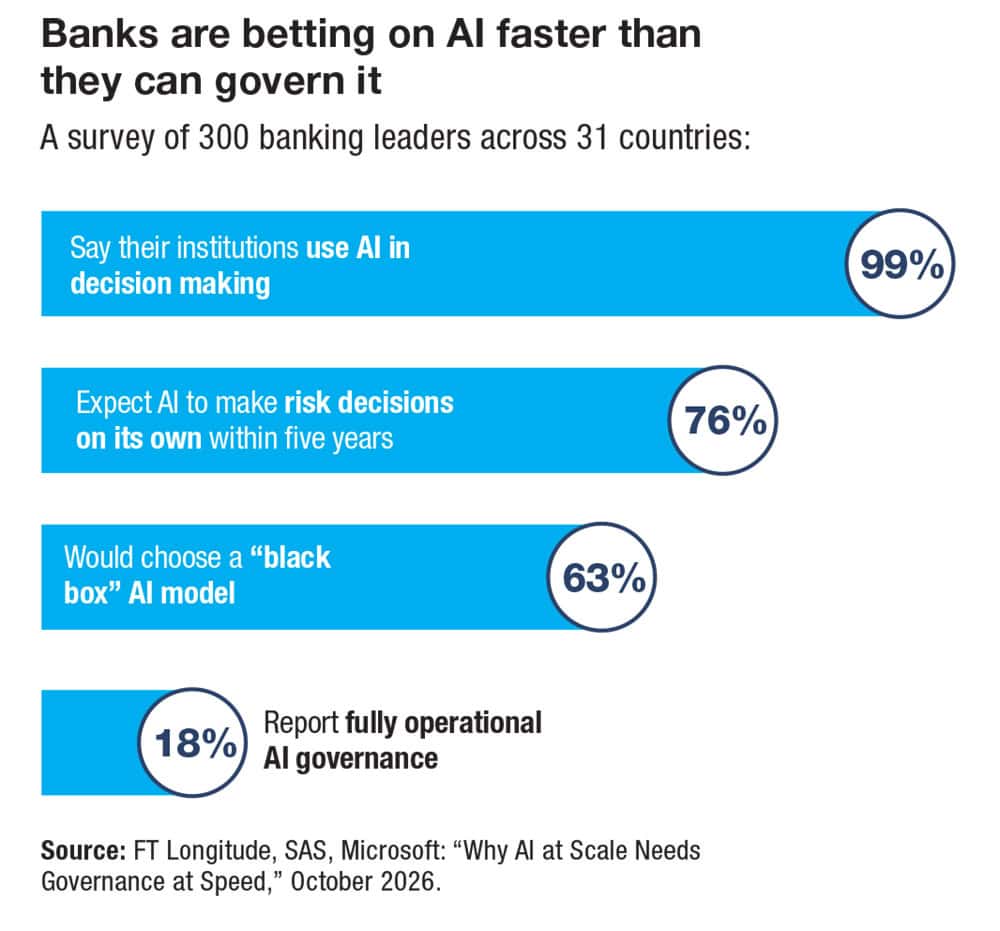
Nearly every banking institution now utilizes artificial intelligence (AI) to support decision-making processes, but only a fraction of these banks have robust governance systems in place to oversee AI usage. According to a survey conducted by FT Longitude in October, commissioned by SAS Institute Inc. and Microsoft Corp., out of 300 banking executives representing 31 countries, 99% of institutions reported using AI in decision-making.
However, only 18% of these banks have operational AI governance mechanisms. This discrepancy becomes increasingly significant as banks integrate AI into their daily operations.
Swiss banking giant UBS Group AG, for instance, has granted over 12,700 employees access to personal AI agents. JPMorgan Chase & Co. has also deployed in-house AI models for fraud prevention, software engineering, and risk identification, although it restricts outside agents' access to its systems due to security concerns. Despite the rapid adoption of AI, many banks prioritize performance over transparency, with 63% of banking executives stating they would favor a "black-box" AI model—meaning a model offering little or no insight into its decision-making process—over a more transparent one if it delivered superior results.
The survey further reveals that 76% of respondents anticipate AI will take sole responsibility for risk decisions within the next five years, with 25% expecting this shift to occur within two years. However, oversight mechanisms are currently lagging behind. Forty-two percent of banks lack AI "kill switches" to halt misbehaving models, while just 19% monitor model drift in real time.
Model drift refers to the phenomenon where a model's accuracy deteriorates due to changing real-world conditions. Only 36% of banks continuously retrain their AI models, failing to adapt them to evolving circumstances.
Anselmo Marmonti, vice president of risk, fraud, and compliance at SAS, emphasizes the urgency of addressing governance and oversight concerns. "The allure of a more efficient model, even without transparency, is strong," Marmonti noted. "Yet, a model that excels but cannot be governed may ultimately undermine more value than it generates."
The pressure to adopt AI extends beyond retail and commercial banking into investment banking, where dealmakers increasingly view AI as vital for maintaining competitiveness. Datasite, a dealmaker firm, conducted a study alongside FT Longitude with 1,000 global dealmakers. The survey found that 62% of dealmakers consider human-only decision-making unacceptable in complex transactions, while 71% believe firms ignoring AI will struggle to compete within the next five years. Furthermore, 24% of respondents contend that poor AI practices could "destroy" high-value deals.
Rewritten by urgent.news; may contain errors — check the original.
Source: gfmag.com