Singapore MRT’s reliability is now three times higher than the target set by Khaw Boon Wan
Disclaimer: Unless otherwise stated, any opinions expressed below belong solely to the author. Reliability statistics sourced from LTA. When Singapore’s “Mr Fix-it”, Khaw Boon Wan, took over the Ministry of Transport portfolio in 2015, Singapore’s MRT recorded delays of 5 minutes or longer once every 133,000 train-km travelled (a measure also known as MKBF: mean […]
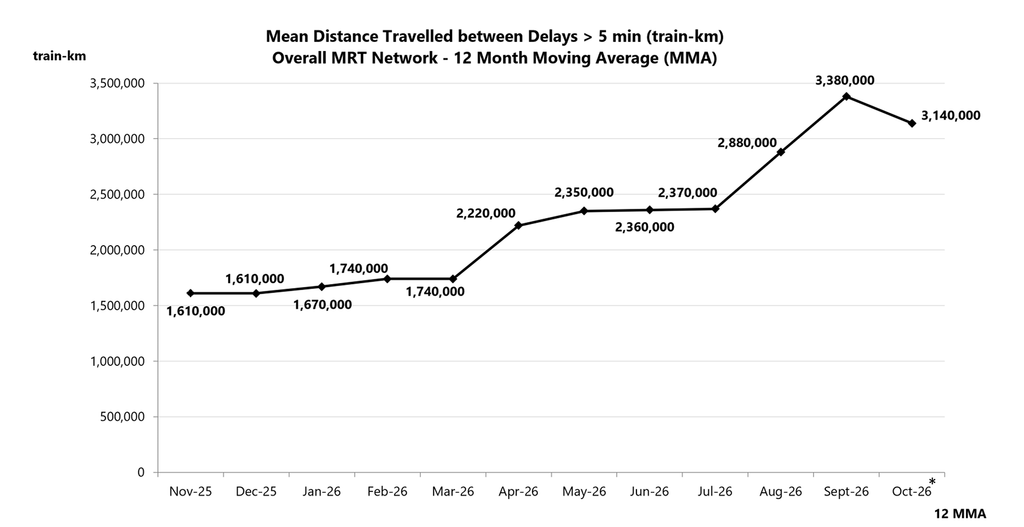
In 2017, Singapore's then-Minister of Transport Khaw Boon Wan announced an ambitious target for the MRT system: reaching 1 million mean kilometres between faults (MKBF) by 2020. Despite initial delays, the MRT recorded delays of 5 minutes or longer only once every 133,000 train-kilometres in 2015. Within just two years, the MRT hit the 1 million MKBF target ahead of schedule, reaching par with Taipei and Hong Kong in terms of reliability.
Khaw himself acknowledged that further increases in MKBF would come at a high cost, questioning whether commuters would be willing to pay for such high levels of reliability. However, by September 2026, the MRT had exceeded 3.38 million MKBF, marking a threefold increase from the original target set in 2017 and nearly twenty times more reliable than 10 years ago. The improvement was significant, with individual lines performing at 2x to 4x the original target of 1 million MKBF.
When compared to other major subway systems worldwide, Singapore's MRT ranks among the best and most reliable. While Hong Kong's MTR has a MKBF of 4.421 million car-kilometres, Singapore's is closer to Taipei's 19.678 million. In terms of train punctuality, Singapore stands at 99.36%, slightly behind Chinese systems and Hong Kong, but ahead of Tokyo and even more so when compared to non-Asian systems in Germany, Australia, and the US.
Rewritten by urgent.news; may contain errors — check the original.
Source: vulcanpost.com