North Korea-Linked PolinRider Poisons Over 7,600 GitHub Repositories to Spread Malware
The threat actors behind the PolinRider campaign have been observed planting a Python loader in GitHub repositories, as evidence emerges that the activity may have started as far back as February 2025. "The loader hides in a small utils package or in conftest.py," SafeDep said in a report published this week. "When Python imports the file, the loader reads the newest transaction that an
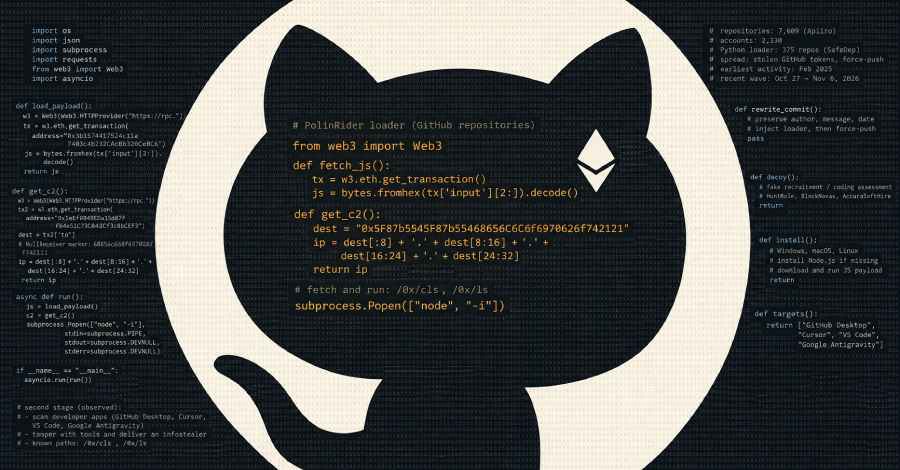
The PolinRider campaign, which has been attributed to North Korean threat actors, has been identified as the source behind over 7,600 infected GitHub repositories. This malicious activity began as early as February 2025, with the threat actors planting a Python loader in various repositories.
The loader, hidden within a small utils package or conftest.py file, infiltrates Python's import process. It retrieves the most recent transaction from an Ethereum wallet and decodes the input data as JavaScript, which is executed using Node.js. The decoded JavaScript then locates the command-and-control server and delivers the next stage of the attack via a detached interactive Node.js environment.
PolinRider primarily operates by compromising developer systems and modifying repositories to distribute malware. It targets various developer tools, such as GitHub Desktop, Cursor, VS Code, and Google Antigravity, to install a stealer that harvests environment secrets, browser passwords, cookies, and wallet data. The malware has been detected in at least 7,609 GitHub repositories belonging to 2,330 accounts, with most of the victims being developers.
Recently, the threat actors have been observed using two additional delivery paths. The first involves a job application requiring a short verification video, which, once the system is deemed compatible, downloads a driver installer. The installer fetches a script from the careers site that installs Node.js, downloads a JavaScript payload, runs it in the background, and then deletes itself.
The second path involves a "Technical onboarding" page with a one-line curl command to download the driver, which performs the same functions on Windows, macOS, and Linux systems.
The PolinRider loader reads the "0x3b1574417524c11a7403c4b232CAcBb320CceBC6" wallet to extract JavaScript code, which then reaches out to the second wallet ("0x1eEf0849EDa15d87f64e51C73C8442Cf3c8bCEF3") for the destination wallet associated with the latest transaction ("0x5F87b5545F87b55468656C6C6f6970626f742121"). This destination wallet address consistently translates to "helloipbot!!" in ASCII, acting as a marker for the PolinRider malware.
Rewritten by urgent.news; may contain errors — check the original.
Source: thehackernews.com