My 4 GB Laptop Can't Run a 27B Model. Nosana Ran It for Under a Cent per Task
A 60-run benchmark tests which zkzkAgent tasks can stay on a 4 GB laptop and which benefit from a 27B model served through Nosana
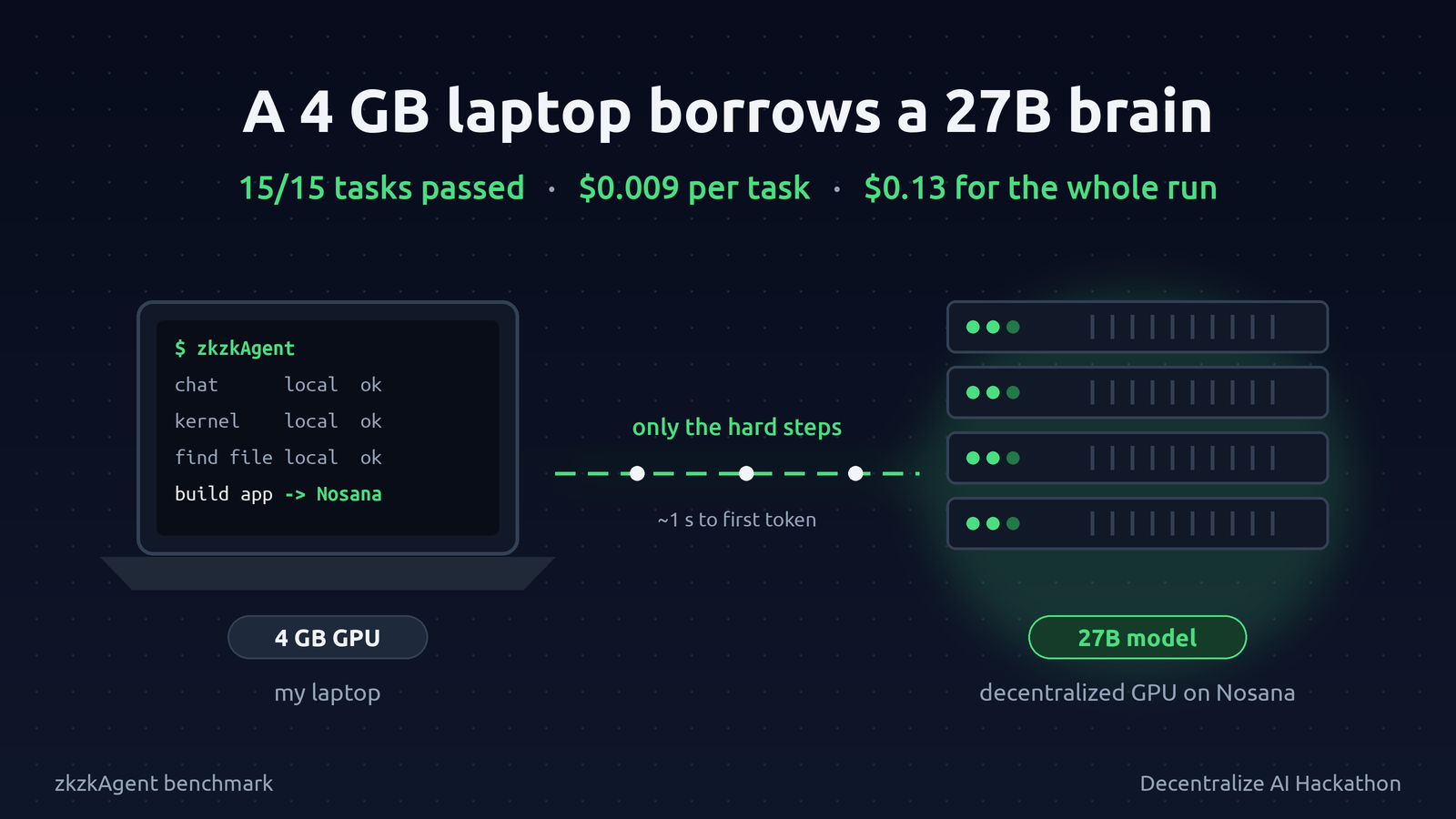
This report covers the results of a project to benchmark the performance of different AI models on a local laptop. The goal was to determine which models could perform certain tasks effectively, and how much it cost to use the larger models remotely through Nosana's GPU network.
The tests used a single AI agent with the same set of tools and prompts, running on a laptop with an Intel i7-10850H processor, 31 GB of RAM, and an NVIDIA Quadro T2000 graphics card with 4 GB of VRAM. The agent's performance was compared between a local Qwen 0.8B model, a Qwen 2B model, a local Qwen 4B thinking model, a Qwen 3.8-27B model on Nosana's API, and the same 27B model locally.
The results showed that the larger Qwen 27B model on Nosana was the most effective and cost-efficient option for the majority of the tasks. It correctly answered all five tasks, at a cost of $0.009 per successful task. Local models struggled with some of the more complex tasks, with the 4B model only completing 12 out of 15 tasks successfully, taking 220 seconds per task on average and costing $0.002 per successful task.
The report highlights that the easy tasks did not require the full capabilities of the large models, and that the actual performance of the models was heavily dependent on their token usage, which was relatively low for the Qwen 27B model on Nosana. The slower local models struggled with tasks that required longer reasoning, which was not a problem for the larger model running remotely.
Overall, the benchmark results suggest that for certain tasks, particularly those involving complex reasoning or larger context windows, the more powerful models can provide better results while still being cost-effective when accessed remotely through a service like Nosana. Local models may still be sufficient for simpler tasks, but they may struggle with more demanding workloads.
Rewritten by urgent.news; may contain errors — check the original.
Source: hackernoon.com